The artist casts an ambivalent gaze on the industrial landscapes of Mumbai’s east coast
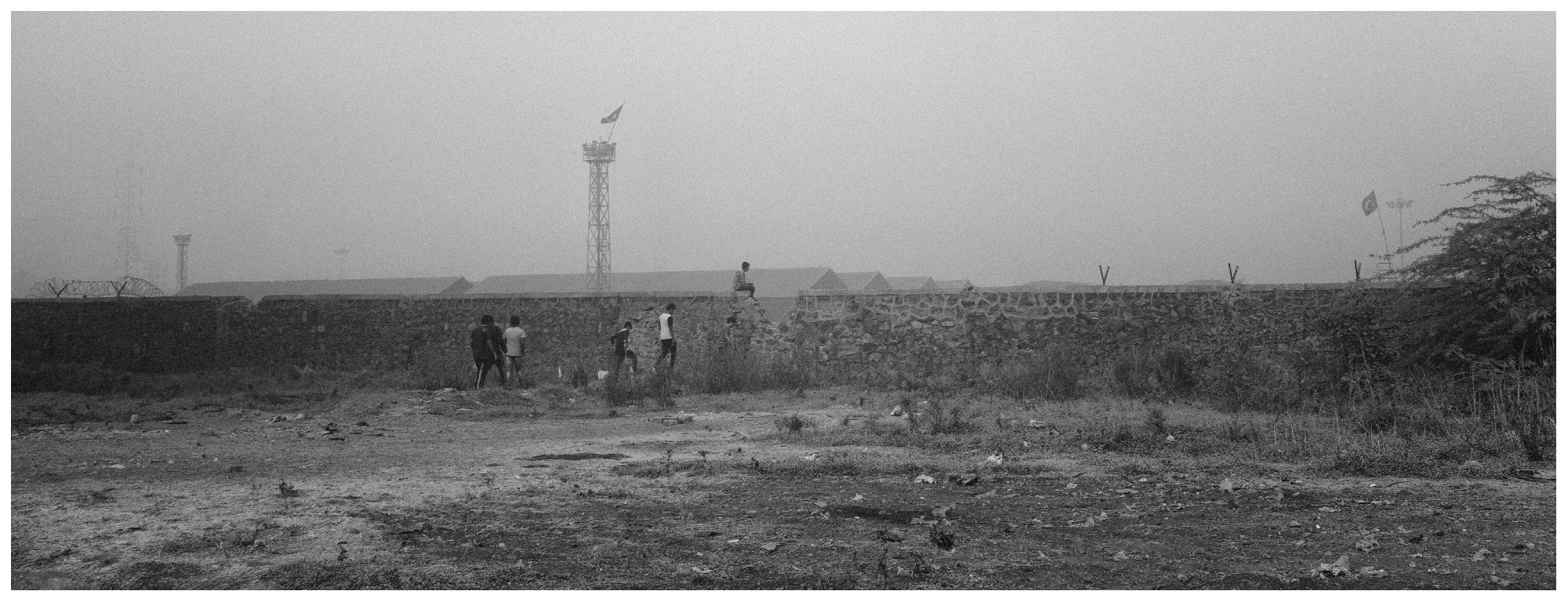
Born in London and with a 20-year career (following his arrival in Mumbai in 1995) in film and advertising, Sunhil Sippy approaches his subject as something of an outsider. Whether that subject is Mumbai’s eastern seaboard or his entry into the world of art and art galleries (this is his first solo exhibition). A wall text introducing the exhibition informs us that the photographs on show have been selected from Sippy’s ten-year archive of largely black-and-white shots captured without a particular plan and relying largely on a subconscious attraction to places and spaces on Mumbai’s east coast (which is apparently less obviously photogenic than the western seaboard). Although the fact that many of the landscapes he photographs have a connection to industrial usage – past or present – might not be as accidental as the wall text makes it sound: his grandparents owned a steel business in Mumbai. And, in any case, taking a photograph – preparing a camera, activating the mechanism at a particular time in a particular place – is never accidental. So maybe accidentally-on-purpose would be more appropriate. And the first impression given to a viewer by the works on show is certainly of a similarly studied entropy.
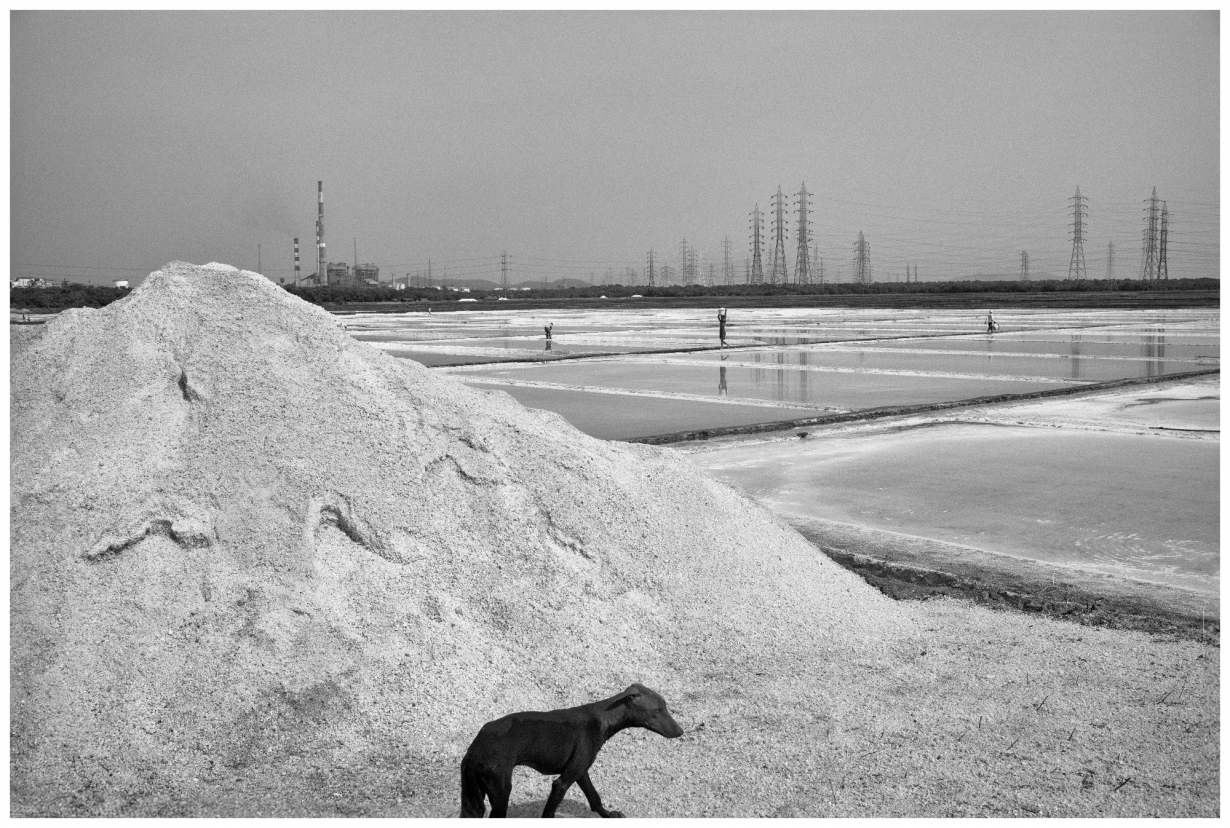
One image looks up the main trunk of a solitary banyan tree (Sewri, 2013 – the title locates the shot in a Mumbai neighbourhood with an industrial port heritage, and petrochemical facilities to the east, that is also home to protected mangrove swamps, famous for migratory flamingos) whose accessory trunks come to resemble the dangling corrugated roofing in a nearby shot of an abandoned warehouse (Sewri, 2025). There are forests of electricity pylons, solitary dogs prowling over slag heaps or salt mounds, or lounging casually amid traces of studied industrial violence in a shipbreakers’ yard (Darukhana, 2015). Hilly piles of waste or displaced materials compounded during the construction phase of Mumbai’s new airport (Navi Mumbai Airport, 2020) and desolate industrial wastelands with the lowslung silhouette of the Deonar slaughterhouse (once the largest in Asia) faintly manifesting in the background (Deonar Abattoir, 2016), are presented, in landscape format, as if they were shanshui ink paintings waiting for a philosopher to contemplate them. And while you can call out the evidence of extraction, pollution (countless smoking chimneys, foggy industrial sites and clouds merging with the bilious clouds they emit), waste, desolation and environmental degradation, Sippy’s images nevertheless convey a curious sense of ambivalence that seems to fit both with the stated origin story of these works and one of the other repeated motifs in the show: of abandoned warehouses being repossessed by nature. As if to remind us that the latter is not simply a victim (yes – you can’t help but be aware that this might be classic marketing speak). It’s that ambivalence that allows us to see the formal beauty in the way a pipeline emerges from the leaves of a forest canopy, or in the clouds of smoke around a funnelled ship in the breakers’ yard that you think could just as well have been there in 1913 as much as they were in 2013, the year this photograph (Darukhana) was shot. And, of course, the fact that all the works are titled with nothing more than a generalised location (meaning that some, that the artist has visited more than once, have the same title but different dates; others the same title and date) further adds to the ambivalent vibe. As if the artist now wants to say that he is presenting us with nothing more than a series of facts, even if those ‘facts’ are contingent and change completely from one image bearing a particular title to the next that bears that same title (see, for example, the two works titled Sewri above). But perhaps it’s precisely this sensation – ambivalence – that most truly captures the attitude that creates these landscapes in the first place. It’s certainly what makes Sippy’s works so hauntingly attractive to look at.
Sunhil Sippy EASTWARD: explorations along Mumbai’s eastern seaboard at Galerie Mirchandani + Steinruecke, Mumbai, through 15 July
From the Summer 2026 issue of ArtReview Asia – get your copy.