The artist is interested in the role clothes serve as both a means of presentation and of concealment
Zhi Wei’s acrylics on stretched fabrics are at once paintings, collages and fabric prints, though at first glance the various materials are indistinguishable from each other. Often depicting imagery inspired by archival finds, these canvases – layers of collaged mesh, floral jacquard and chequered gauze, sometimes opaque, mostly sheer – are entirely devoid of brushmarks. The application of paint is sleek and thin, hidden between the semitransparent layers such that it’s often hard to tell what’s painted and what’s printed fabric. As each layer of imagery adds to the previous, it equally obstructs what comes from behind, at once concealing and revealing the murky images of vases, shells and other such design motifs that emerge from this process.
The artist’s first solo exhibition at Beijing Commune presents nine new works of the like. Zhi, whose family runs a textile business, is interested in the storytelling capacity of the material, as well as the role clothes serve as both a means of presentation and of concealment. Two compositions from the Shell series (2025–), for example, picture an enlarged snail shell, referencing, we’re told by the handout, the abodes where ‘Far Eastern’ people lived in the medieval Western imagination. Shell 001 (2025) features a ‘shell house’ on a plain at nighttime; its opening leads into a black void, while a dark, glittery mesh fabric pulled taut over the painted canvas veils the entire scene like a starry sky. Though a homely gingham pattern dapples here and there, the overall feeling is one of secrecy and retreat rather than invitation – an uncomfortable split that tints the medieval fantasy with an undertone of alienation.
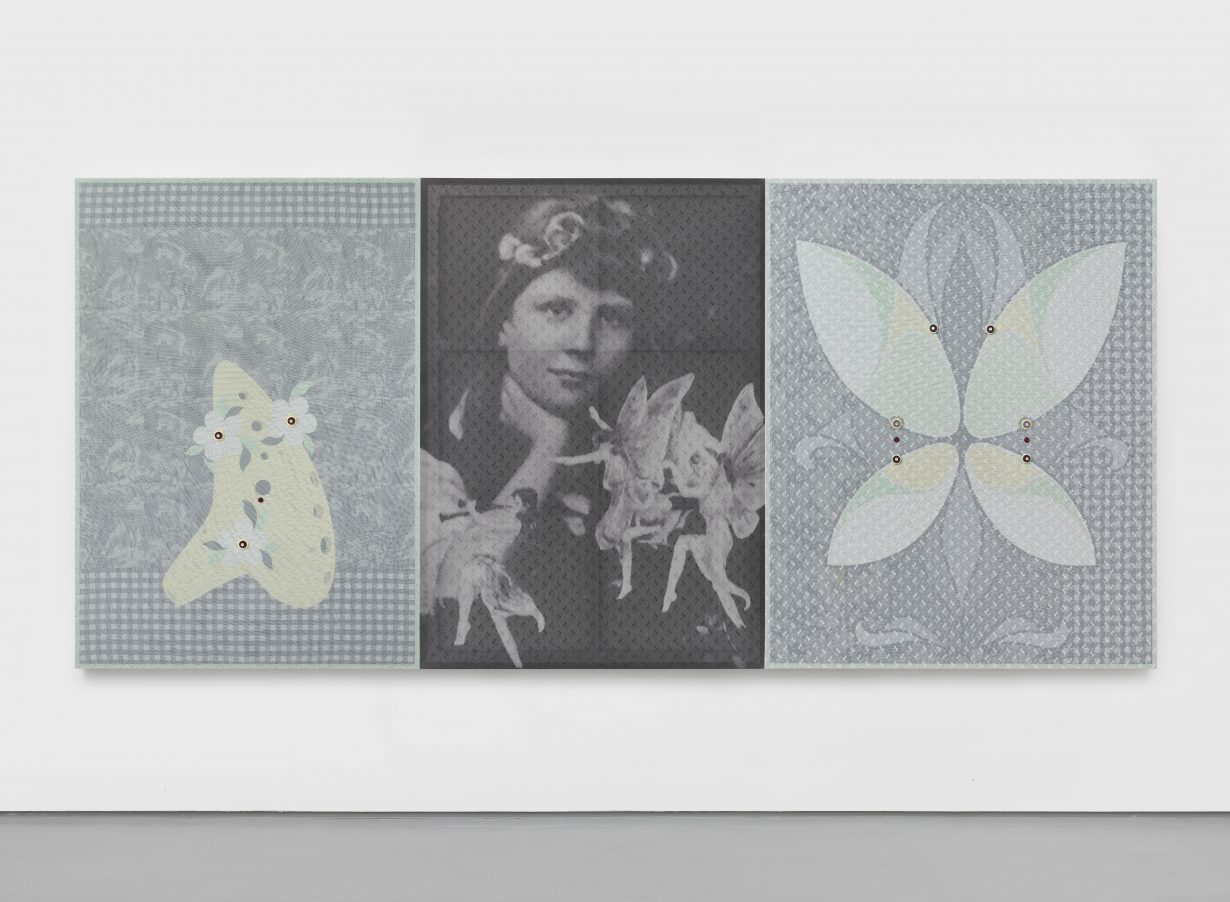
In The Cottingley Fairies (2024–25), a blackand-white photocollage from 1917 is printed over layers of lace and mesh, showing a girl flanked by dancing fairies. In the 1920s the picture circulated widely in the printed press as ‘evidence’ for the existence of these winged creatures, only to later become an exemplar of how photography fabricated truths rather than revealed them. Behind the fabric(-ated?) picture, the shapes of the wooden canvas stretcher are visible. It is tempting, if somewhat clichéd, to see this as a literalisation of looking through a picture rather than at one – and by extension, of truth as something layered and murky, but also flimsy and frail. But the experience of simply staring at the work is mesmerising. The fabric, of which overlayed fishnets form a morphing moiré pattern, left me wondering about the textures of a fairy’s diaphanous wings.
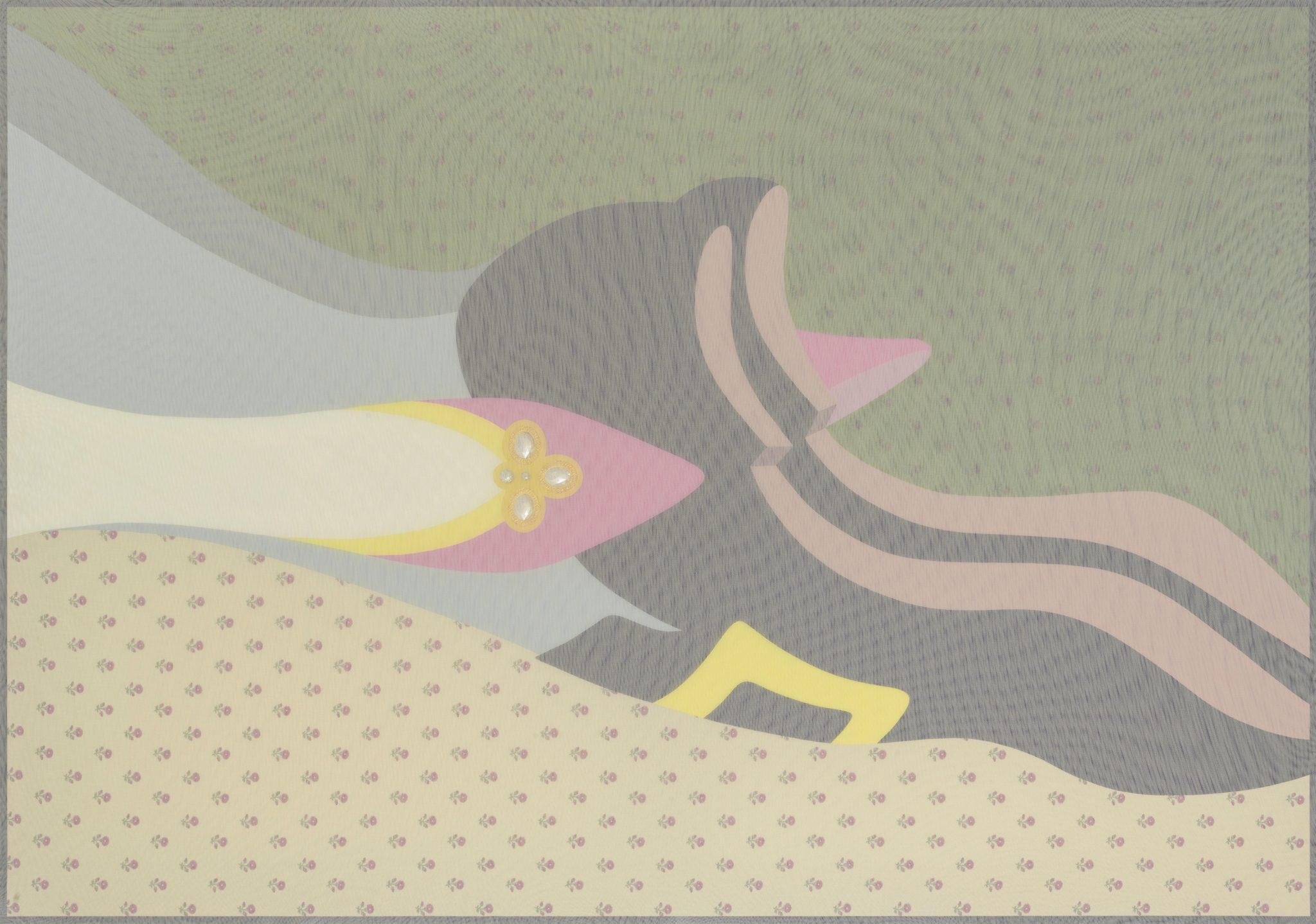
At times Zhi’s compositions sport a vaguely sexual undertone. Ocarina (2024–25), for example, pictures the titular vessel flute on a floral background. The instrument poses like a Graeco-Roman torso in contrapposto, and stacks of two or three buttons are studded to places where one might imagine private parts and a belly button. In the cream-coloured Fashionable Contrasts (2025), this takes on an uneasy bent. The composition shows two pairs of calves – those of a man in between those of a woman – stretching across the canvas. They’re each clad in baroque-looking shoes – one black and buckled over blue hose, the other a pair of dainty, bejewelled slippers – stylistically conjuring what might be illustrations in a book of fairy tales. The tangled limbs, however, point to a sexual act in progress: the man’s shoes are significantly larger than the woman’s, making the lady look disturbingly young and frail. But the cruelty of all this feels as if silenced by the innocent, homely materiality and style – the bed they lie on is suggested by an actual piece of floral bedsheet, and a top layer of white mesh evokes a cozy bed curtain. What makes Zhi Wei’s works endlessly fascinating is the delicate way their imagery and stories unfold, leaving us enmeshed in the experience of looking, and all the dissonance that’s in between.
Zhi Wei: Folly at Beijing Commune, 16 May – 11 July
From the Autumn 2026 issue of ArtReview Asia – get your copy.