***Subscribe now or get your copy from our online shop***
In the wake of the Venice Biennale, and global politics more generally, national identity – what is it? How does it get decided? – is a hot topic in the artworld. So, in its summer issue, ArtReview looks at our relationship with places – not as political entities, but as geographies and terrains. How do landscapes influence the lives of those who live in their midst? And conversely, how do we change and alter the land on which we live and work?
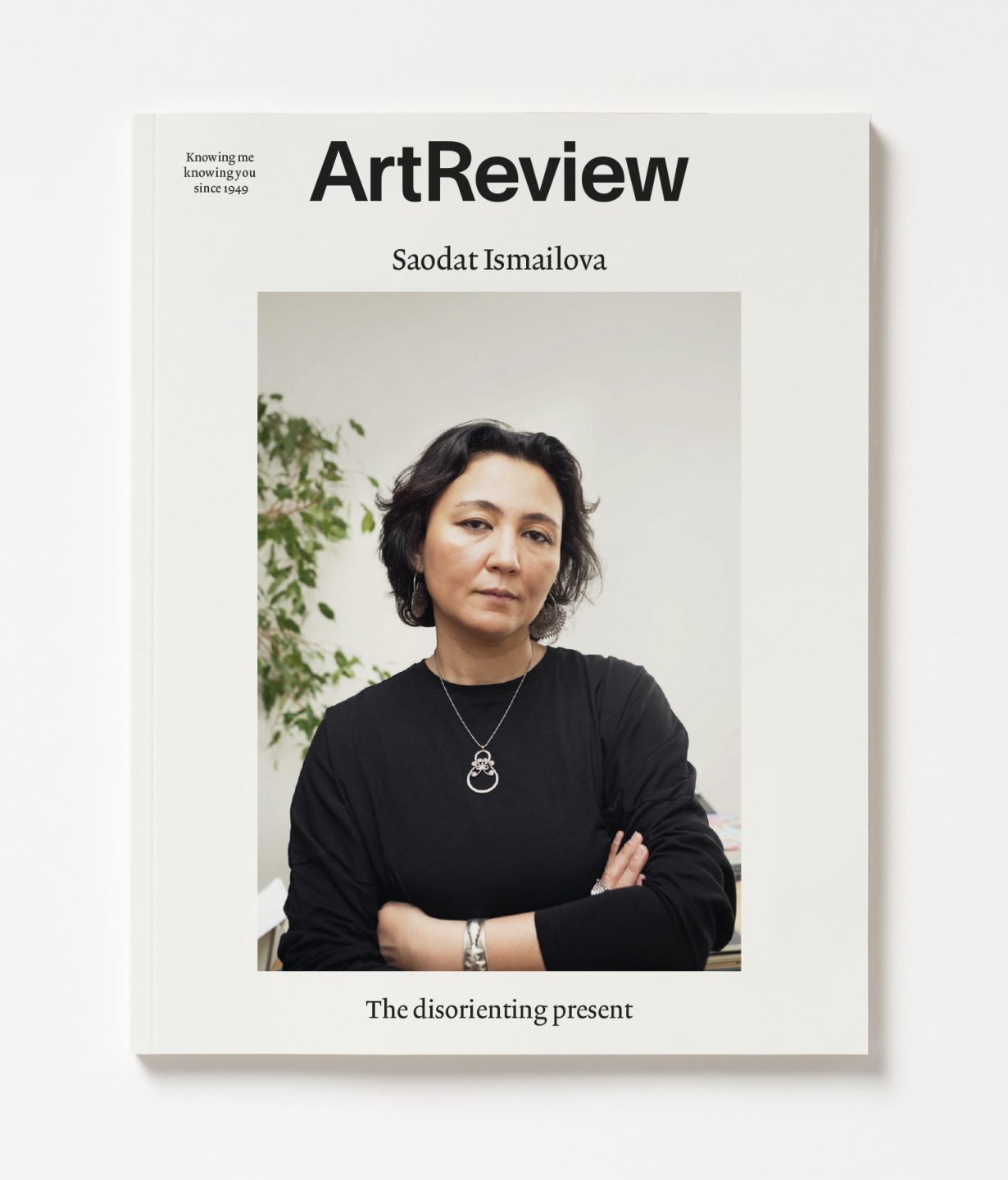
Across a more-than-two-decade career, Uzbek filmmaker Saodat Ismailova has consistently turned her lens towards the cultures, ecology and suppressed histories of Central Asia – a region profoundly reshaped by Soviet industrialisation, secularisation and the environmental devastation caused by intensive agricultural and mining practices; her work, writes Fi Churchman, highlights ‘the gap between what once existed and what remains.’ Shuruq Harb, who also makes moving images, talks to Stephanie Bailey about her mission to find a way, beyond politics, to talk about Palestinian history, tracing the land through its people and ‘navigating the world as a complex, temporal accumulation of narrative fragments rather than an impenetrable totality’. For Colombian Ana María Devis, the geography she is interested in is a domestic one: a recent forensic body of work has focused on a bed, found rotting and stained after the death of a friend’s father and a subsequent leak in the apartment; Chiara Wilkinson explores how the familiar becomes abject.
Even the father of conceptualism Marcel Duchamp felt the need to locate himself: for him, art was not an abstract value, and was only present in the physical encounter between the viewer and the object. We must ‘approach his works as sites of shared labour’, Jenny Wu writes as a major survey occupies MoMA, New York. Martin Herbert, on the other hand, turns to another of the twentieth-century’s big hitters, Francis Picabia, an artist whose work continually showcased an evolution of styles and mediums, whose chief consistency was inconsistency, but whose legacy remains vital precisely because it is unlocatable. So maybe you should ignore all the above.
Also in this issue, Jenny Wu goes several rounds with the Philadelphian legacy of movie character Rocky; a new translation of an alien-inspired comic from the 1980s sheds light on our unreal present, finds Jamie Sutcliffe; in Palermo, Mariacarla Molè pays homage to a city building an audience for art from the ground up; Nobel Laureate Olga Tokarczuk’s recent comments on her use of AI in ‘preliminary research’ have hit a nerve – and rightly so, says Helen Charman; the images that emerged from the Arsenal men’s football team’s Premier League win in May serve a potent reflection of society argues Clive Chijioke Nwonka; while in The Interview, Nicholas Goodly tells Jessica Lanay that poets shouldn’t shy away from being divas.
Plus reviews of exhibitions by Marina Abramović in Copenhagen, Katrina Palmer in Rotterdam; Lina Lapelytė in Berlin; Lynette Yiadom-Boakye in New York; Patricio Morocho in Lima; and much more; alongside reviews of books by philosopher Byung-Chul Han, art theorist Daisy Dixon, journalist Amelia Abraham, architecture critic Irénée Scalbert, artist Lawrence Weiner and travel writer Cal Flyn.
***Subscribe now or get your copy from our online shop***