The artist reflects on the histories and contemporary reality of Chinese labour and migration
Marcos Kueh’s solo exhibition takes visitors across turbulent seas. Borrowing its title from a Chinese expression commonly offered as a farewell blessing to travellers, Smooth Sailing was developed during the artist’s recent residency at ESEA Contemporary. It is a layered reflection on the hope, excitement and vulnerability that reflects upon the global movements of people and goods.
Kueh’s research into the history of the British labour movement and migrant workers in the country informs a new body of sculptures, tapestries and a largescale installation, displayed across two gallery spaces. Hung as a partition at the entrance to the main gallery, Woven Poster: Spirit of Labour (all works 2025) greets visitors with a visualisation of prosperity. In the centre of the tapestry, a golden ship with a dragon-shaped figurehead and a heavily decorated hull is in full sail. A plethora of symbols and inscriptions in traditional Chinese surrounds the ship. The layout of the tapestry references nineteenth-century trades-union banners Kueh found in Manchester’s People’s History Museum. However, while keeping slogans like ‘united we stand, divided we fall’, the artist has replaced the traditional portraits of Greek goddesses that typically appear on such banners with symbols of luck and protection – such as auspicious clouds and Buddha eyes that are familiar to many East Asian cultures. These hopeful motifs evoke the history of Chinese labourers whose search for a better life brought them to northwest England during that century.
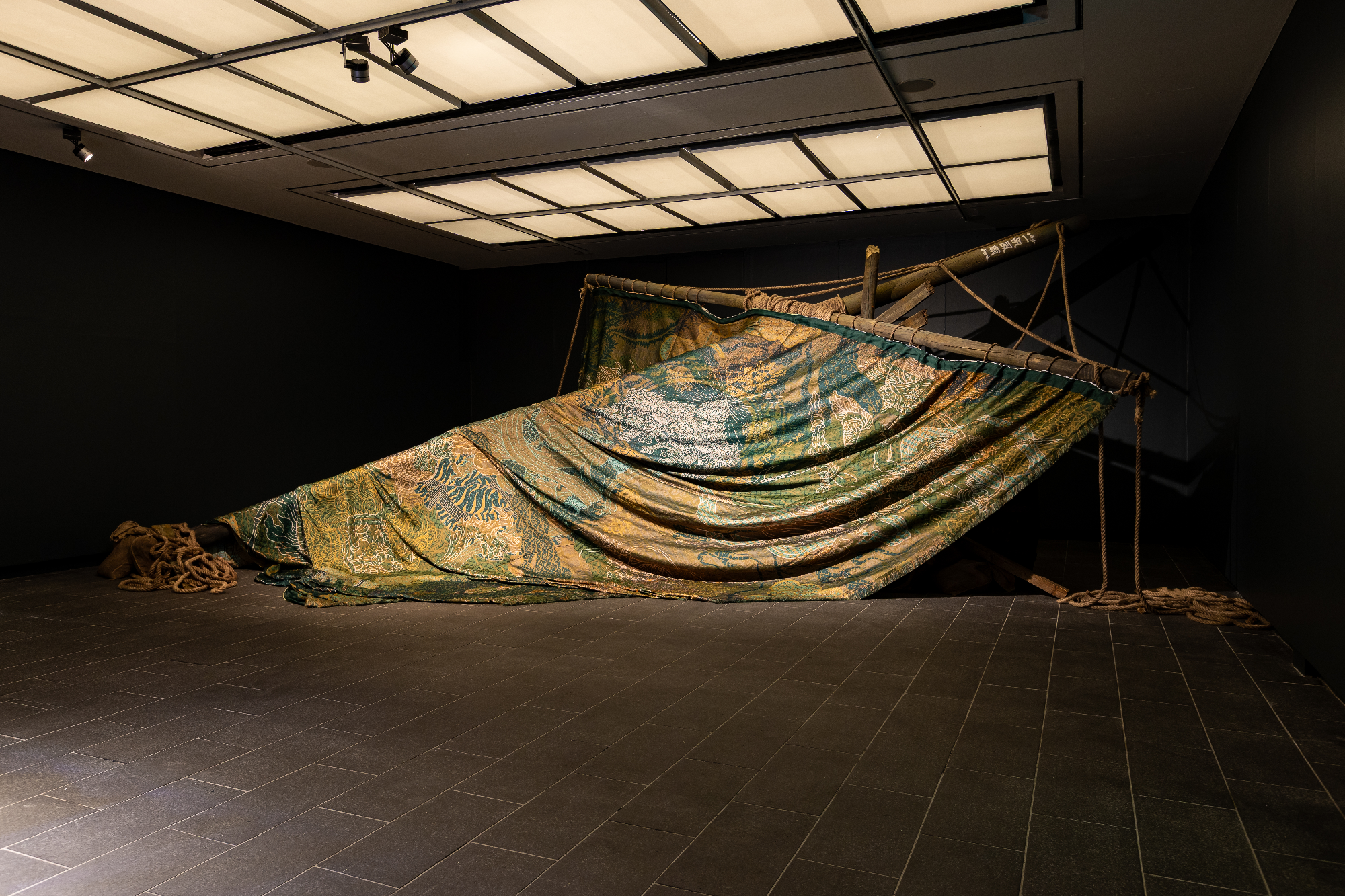
The migrant journeys on which Kueh’s work reflects are convoluted. In a darkened gallery behind the tapestry, visitors are confronted with what looks like remnants of an unidentified catastrophe (Abandonment). Half of the space is occupied by a massive sail that theatrically shrouds a broken mast. Intricate motifs of guardian deities and talismanic inscriptions embellish the sail, but their purpose will remain obscure to visitors unfamiliar with their meaning. On the opposite wall, a textile installation titled Hope and Fear speaks of the uncertainty that often accompanies the search for a ‘better future’. Beneath frayed black gauze, dark fabrics that have been distressed and handsewn by Kueh carry glistening embroideries of vintage-looking trademarks. Forming a shadowy maplike shape, the installation feels like a trace left by ill-fated voyages undertaken by people and artefacts.
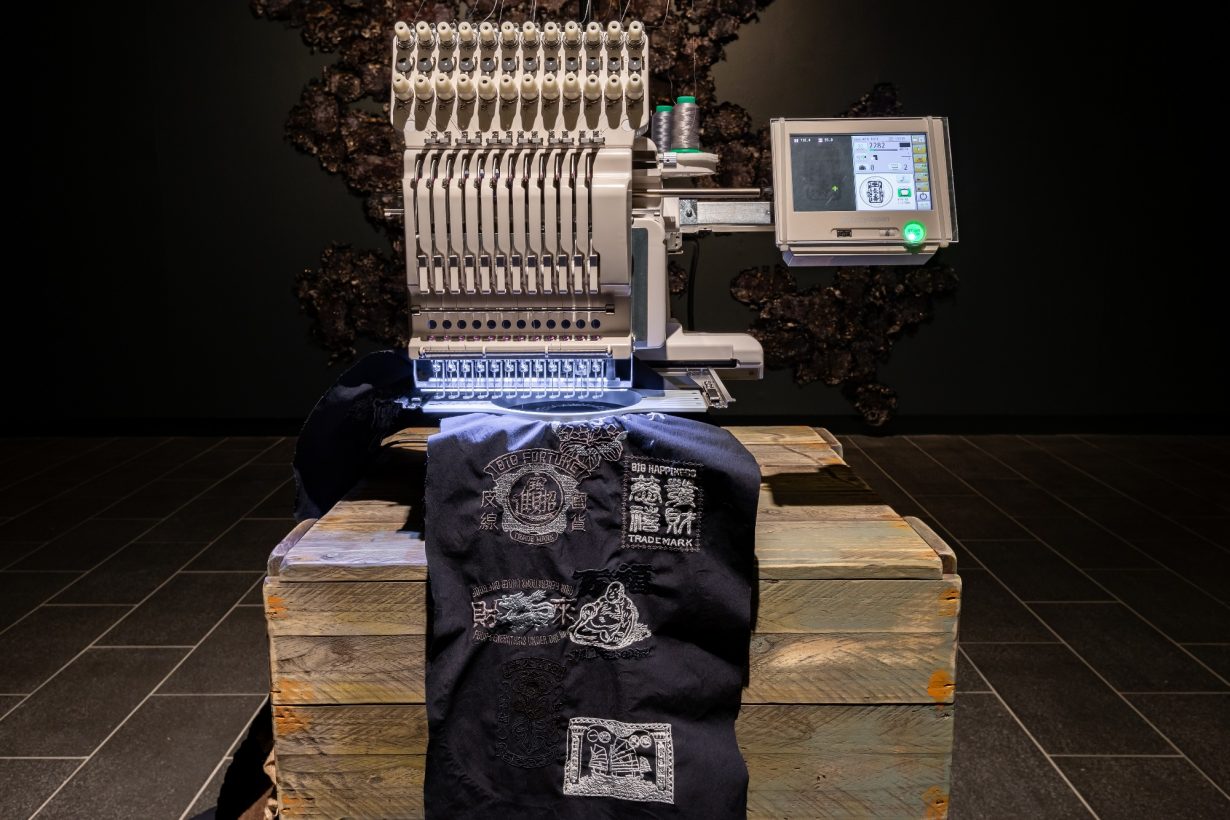
By using deadstock fabrics – excess materials from the textile industry – Kueh situates Hope and Fear in the global network of production and trade. Nearby, as if embodying the isolation and exploitation endured in this network by nameless workers, an industrial embroidery machine works alone and nonstop (Love, Labour, Loneliness). Under the machine’s pale-blue illumination, the auspicious symbols become commercial decorations conjured up swiftly by its automated needles from digital files visible on a small digital screen. Seen together, the two works connect the diasporic story of hardship and uncertainty with the reality faced by workers in distant outsourced factories, whose exploitation of hope and labour continues to fuel the circulation of goods and capital. Through the street-facing windows of ESEA Contemporary’s Communal Project Space, the Chinese deities of luck, prosperity and longevity reimagined in Kueh’s Three Contemporary Prosperities series of tapestries glare at passersby like brand ambassadors in contemporary billboard advertising. These traditional figures, now given tongue-in-cheek names like The Perfect Celebrity, wear robes and headdresses adorned with dollar signs, Nike logos and social-media app icons. In an age in which old wishes have become absurd desires, Smooth Sailing presents a probing meditation on the new reality and meaning of migration, labour and hope.
Marcos Kueh, Smooth Sailing, 一路順風, ESEA Contemporary, Manchester, 25 October – 11 January