The artist’s work echoes notions of the Red Army Faction as a ghost entity – and a fading memory
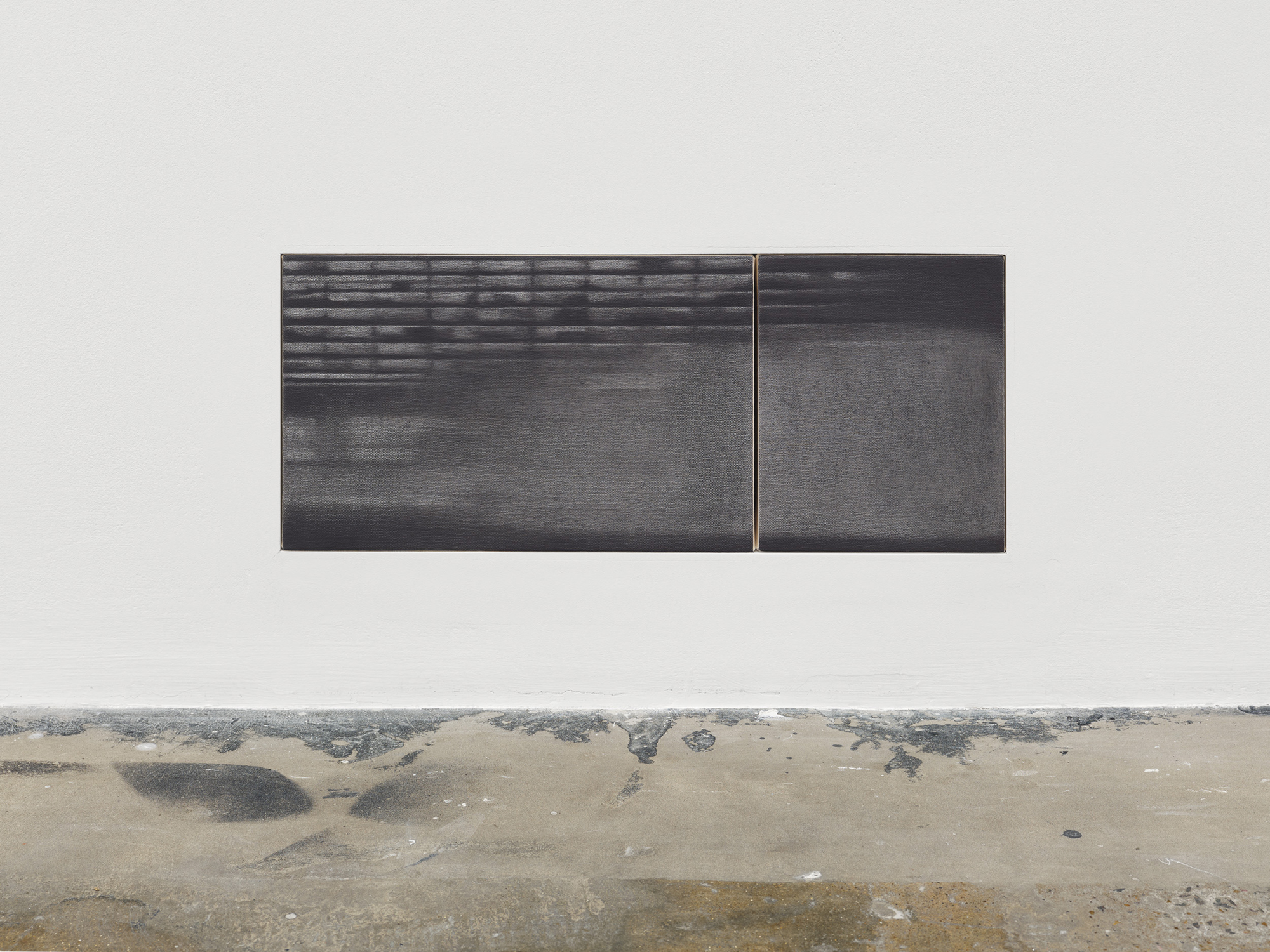
Maren Karlson’s LAG is named for the last three letters of Axel Springer Verlag: four of the six dark-toned, frequently wide-format, near-abstract oil-and-graphite paintings in the exhibition (LAG #1–6, all works 2026) use source material from the conservative German newspaper conglomerate’s own archive. Here, the German-born, Los Angeles-based Karlson paints – in an oneiric, highly distorted, digitally adjusted manner – from newspaper images of the 1968 student protests, following the attempted assassination of former Springer journalist and radical student leader Rudi Dutschke – and claims that Springer titles were being used to manipulate public opinion – outside the Springer HQ itself. The events of that year became the catalyst for the founding of the Red Army Faction (RAF). Accordingly, in opposite corners of the room, a further two L-shaped canvases depict an assassination via car bomb during the RAF’s 1980s third-generation militant renaissance.
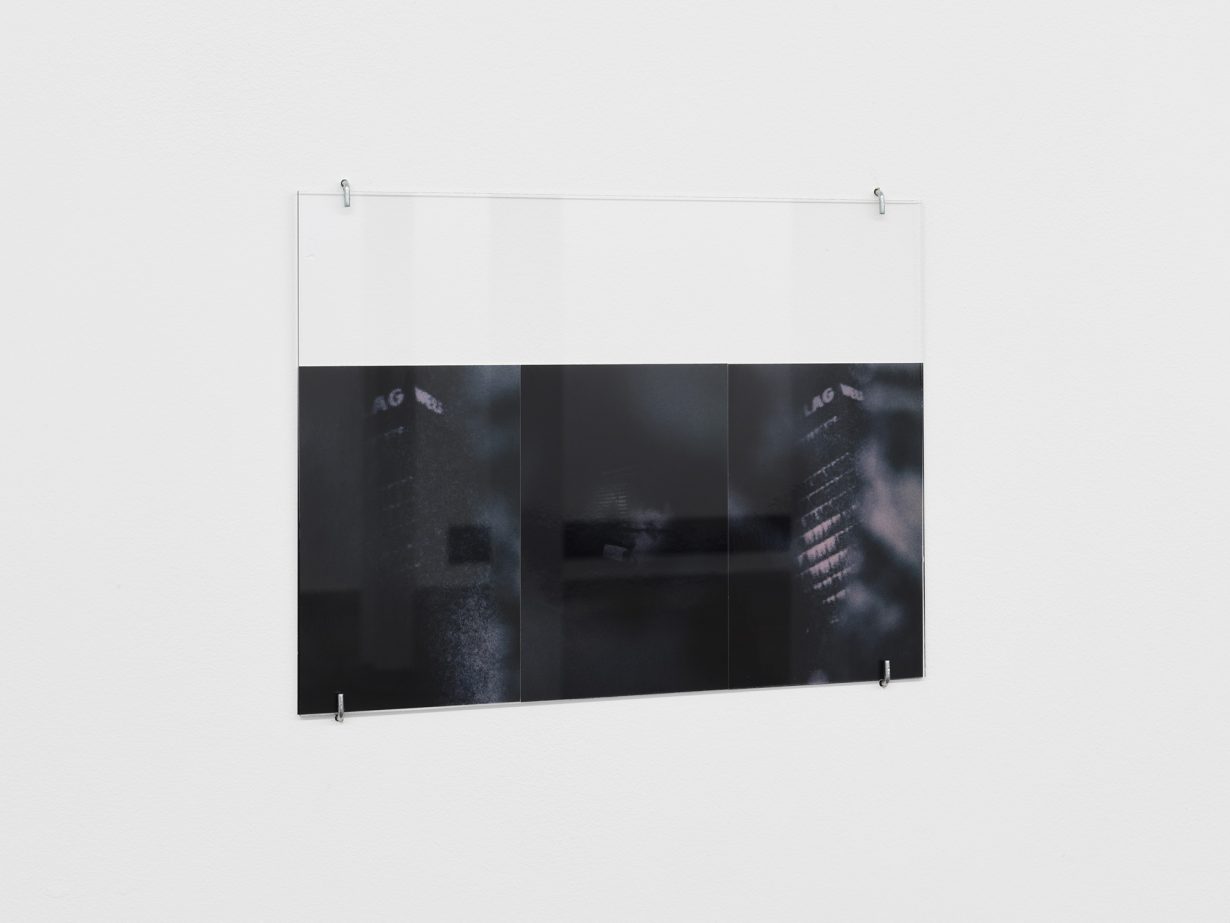
Across the room, continuing the theme of journalism and antagonism, are two photographs, LAG #7–8. A kind of diptych, placed beneath plexiglass, these realise a spy trick from Harun Farocki’s student film Their Newspapers (1968), in which undercover reporters observe members of an urban guerrilla group through holes in newspapers. In her work, Karlson cuts a slit in archival articles on the (later) actions of the RAF, photocopied from the Springer Verlag public archive, through which to observe a second archival image of the Verlag HQ. Through the slit, we see the crenellations of Springer Verlag’s architecture; its sign truncated so only LAG is visible. In LAG #1 and LAG #2, Karlson paints a mutated archival image of the same building: stretched in Photoshop, so that its regimented windows become infinite, attenuated cells, half-obscured by clouds of smoke from burning newspaper trucks set ablaze during student protests.
Each of the LAG paintings sits within a specially created low alcove in the gallery’s industrial-chic architecture, around 25 centimetres above the concrete floor. In the austere, white space, the greyish works appear like footnotes. The recess, in turn, acts as a symbolic fenestella, a medieval architectural niche that allowed for genuflection (kneeling) by devout pilgrims – a choice in keeping with the deifying culture around RAF leaders Andreas Baader and Ulrike Meinhof’s posthumous cult of personality. Karlson’s works expand upon German cultural theorist Klaus Theweleit’s description (in an exhibition text for a 2005 show at Berlin’s KW Institute, Regarding Terror) of a ‘reality-sign RAF’. Karlson builds on that show’s main tenet: that the faction became hyper-abstracted, an entity chiefly formulated by media representations. Her canvases echo notions of the RAF as a ghost entity, living only inside the imagination of a fearful public or an anxious government. Moreover, they maintain a distance from the notion of ‘the revolutionary body’, to which German artists have historically been attracted (think, inevitably, of Gerhard Richter’s 1988 October 18, 1977 series, based on forensic photographs and portraits of four militants – three of whom are generally thought to have been executed by state police on the date in question while in Stammheim prison). Although both artists lift from the archive of mass-media images, and Karlson’s technique of physically stretching images in Photoshop, to the point of unrecognisability, prior to painting them, recalls Richter’s squeegeeing of his wet oils, there is a sense that Karlson’s canvases allude to the manipulation, or fading, of collective memory.
Maren Karlson: LAG at Soft Opening, London, 11 September – 17 October
From the October 2026 issue of ArtReview – get your copy.