Presented as a historical model, Group Material’s methods consider how we might rethink infrastructural critique for our own times
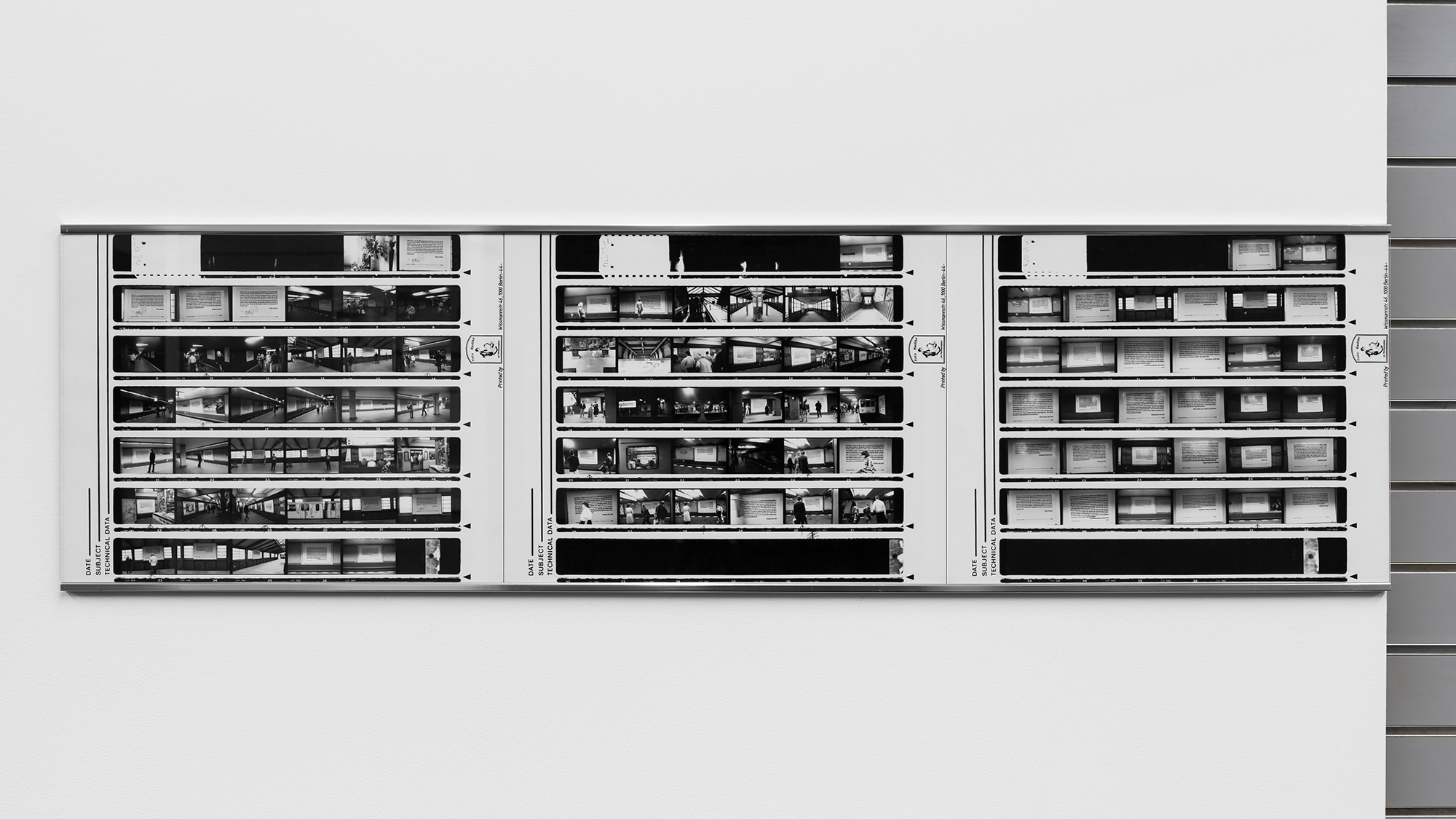
Installed across subway spaces in New York and a building facade in Freiburg im Breisgau, Germany, the exhibition Mr. Nobody re-engages a number of Group Material’s projects, presenting a snapshot of their output from 1979 until 1996. Including artists Julie Ault, Tim Rollins, Felix Gonzalez-Torres and Doug Ashford, among others, the collective fashioned a new flavour of institutional and political critique that made visible society’s dependencies and complicities – tackling everything from the question of democracy in Germany to the US government’s interventions in Central and Latin America. In New York, ephemera spanning years of projects are displayed on the walls of Emmelines, a gallery in the Fifth and 53rd St subway station: enlarged contact sheets of passersby stopping in the U-Bahn to read the Democracy Poll/Demokratische Erhebung hang alongside a questionnaire asking citizens, in the year after the fall of the Berlin Wall, about their hopes for the future of Germany.
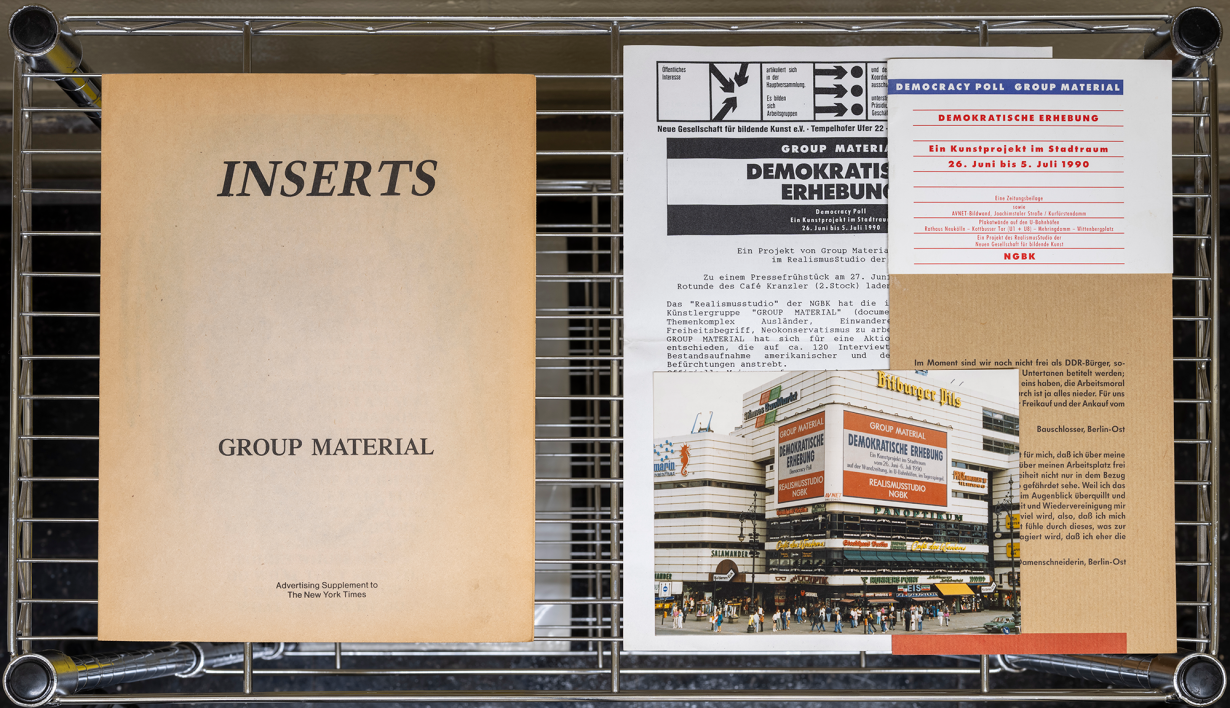
The exhibition is, fittingly, centered around Subculture (1983), a project that replaced advertisements in the New York City subway with original works by over a hundred artists and which gets memorialised in the exhibition through mounted wall texts of David Wells’s poetic Subway Readings (1983/2026) and documents of the exchanges and logistics that allowed the project to happen. Indeed, aside from a few notable exceptions – a copy of Inserts (1988), where a packet of single-page artworks was slipped into the Sunday edition of The New York Times, and a plastic Shopping Bag (1989), which lists the luxury capitals of the world on one side and global arms-dealing centres on the other, offering the type of searing critique of unconscious consumption that became the group’s trademark – Mr. Nobody privileges the how over the what.
The resulting homage is less a didactic lesson in Group Material’s practice and more a careful translation of their motivations. The numbing effect of viewing such artefacts from the distance of our present – divorced from the social and political context that gave the projects their notorious bite – paradoxically underscores the urgency of studying their aesthetic strategies. By offering Group Material as a historical model, the show creates a space to rethink social practice, offering a subtle demand for a refreshed infrastructural critique tailored to our own times.
Because as much as Mr. Nobody offers a portrait of Group Material, it is equally a study in how things are remembered: asking if and how we can engage with an archive without reducing it merely to a cypher for the present. By focusing on artefacts of the group, the exhibition reminds us that Hydra-like social issues require an equally shapeshifting set of solutions. Perhaps this is why Group Material has so ardently opposed formal retrospectives of their work. Had Emmelines pulled out and displayed some of the group’s more controversial works – say, the Da Zi Baos (1982) or the AIDS Timeline (1989) – as art, the exhibition would have undermined the group’s constant prodding of the edge between art and society and their interrogation of ‘how is culture made and who is it made for’, as a statement they wrote in 1985 asserts. Instead, Mr. Nobody offers their archive more as loose inspiration: proof of concept for a rigorous – though not humourless – critique of apathy in all its forms.
Mr. Nobody at Emmelines, New York, 6 June – 25 July