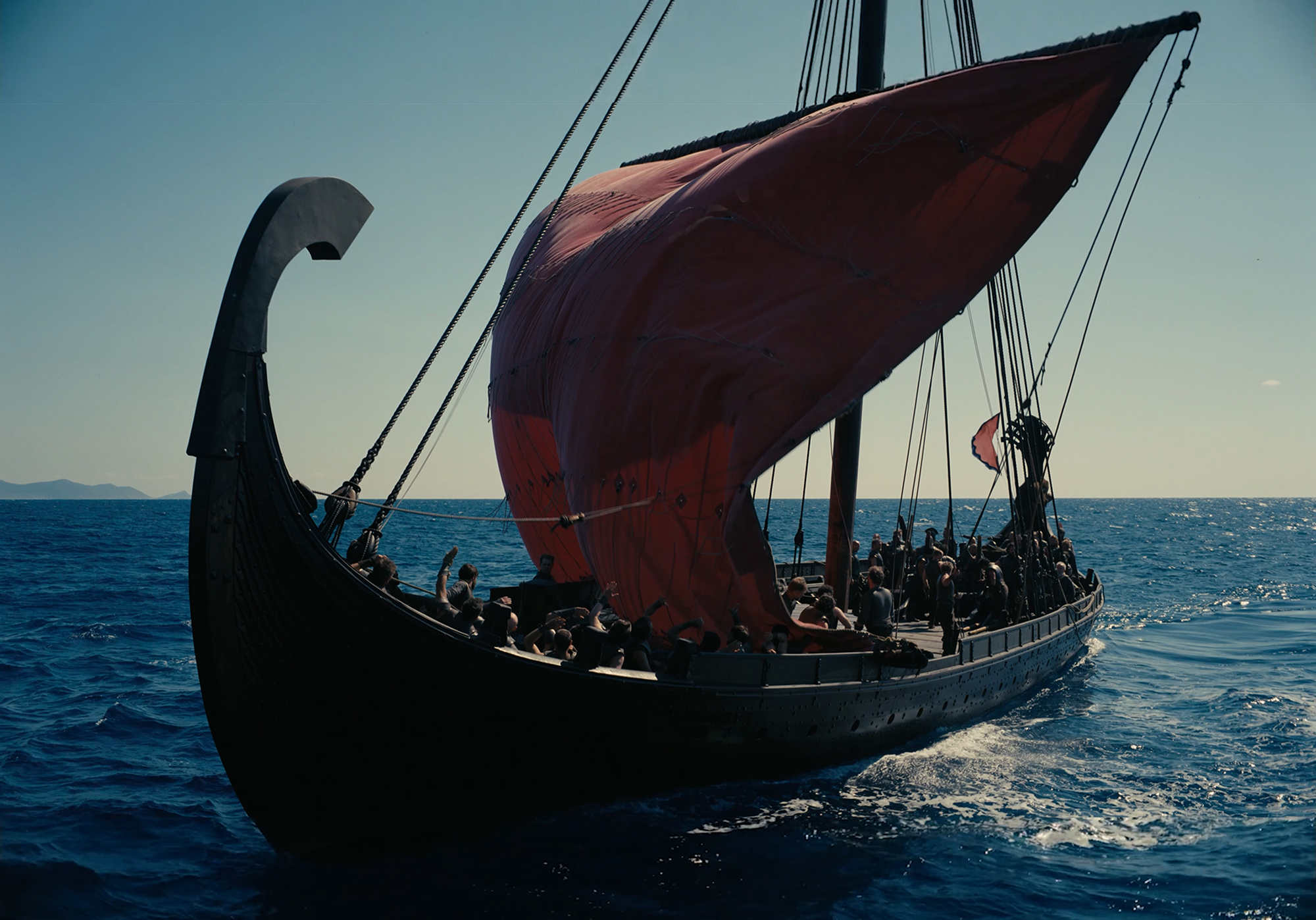
Christopher Nolan’s adaptation goes for modern psychology over textual ‘fidelity’, eschewing not just the silliness of toga-clad deities perched in the heavens, says Beatrice Loayza, but the itchiness of dogmatic truths
From the magicians in The Prestige (2006) to the dream-engineers in Inception (2010), Christopher Nolan’s heroes have always strived to exert mastery over the mysteries of the world – a struggle consistently met with the same conclusion: “Don’t try to understand it, just feel it”, per ‘The Protagonist’ in his elliptical time-travel thriller Tenet (2020). The scale and complexity of his worldbuilding, and his technical virtuosity, certainly aims to harness the full sensory force of cinematic spectacle, but for all the rushing memories and cleverly calibrated countdowns orchestrated to judder your emotions in his films, such a sensitivity can also feel elusive. Even Oppenheimer’s (2023) race to unleash the A-bomb exhausts more than it horrifies or enthralls, playing like a trailer for the end of the world with rubbery performances, lumbering exposition and portentous style desperately working to manufacture the audience’s feelings at the cost of stifling them altogether.
Much to my surprise, The Odyssey, Nolan’s latest big-budget spectacle, pulls back. In this ‘time of apparent magic’, as the opening titles describe, the Gods preserve some of their mystery; and Nolan, too, offers a relatively grounded – and as such more sensuous – take on the classic than his previous work would suggest he was capable of. The Odyssey spurns textual fidelity, or whatever that means for an epic poem composed orally over centuries and written down in what even ancient Greeks understood as strange, elliptical vernacular. Nolan’s thematic lens is modern psychology, making Matt Damon’s Odysseus a strapping, guilt-ridden genius in the face of civilisational collapse – a quintessential Nolan hero.
While there’s a certain arrogance in inserting oneself into a lineage that includes Virgil and Dante, if not Wolfgang Peterson, before him, I don’t think the text is above a commercial guise. There’s a scene in which Samantha Morton’s sorceress Circe turns Odysseus’s men into hogs with the finesse of a potter shaping clay on a spinning wheel, and it reminds us that Homer’s Odyssey persists in our cultural imagination not because its fixed meaning resonates across centuries, but because its fantastic images retain a sort of intuitive power, one that has lent itself as readily to storybook adaptations that burrow into children’s minds as it does minimalistic experiments such as Franco Piavoli’s Nostos: The Return (1989). Reducing Odysseus to a PTSD-inflicted war veteran is a lame simplification, yes, but the fertility of the template also keeps Nolan from writing himself into a ditch, allowing (as in his best film, 2017’s largely wordless World War II epic Dunkirk) his images to do the heavy lifting.
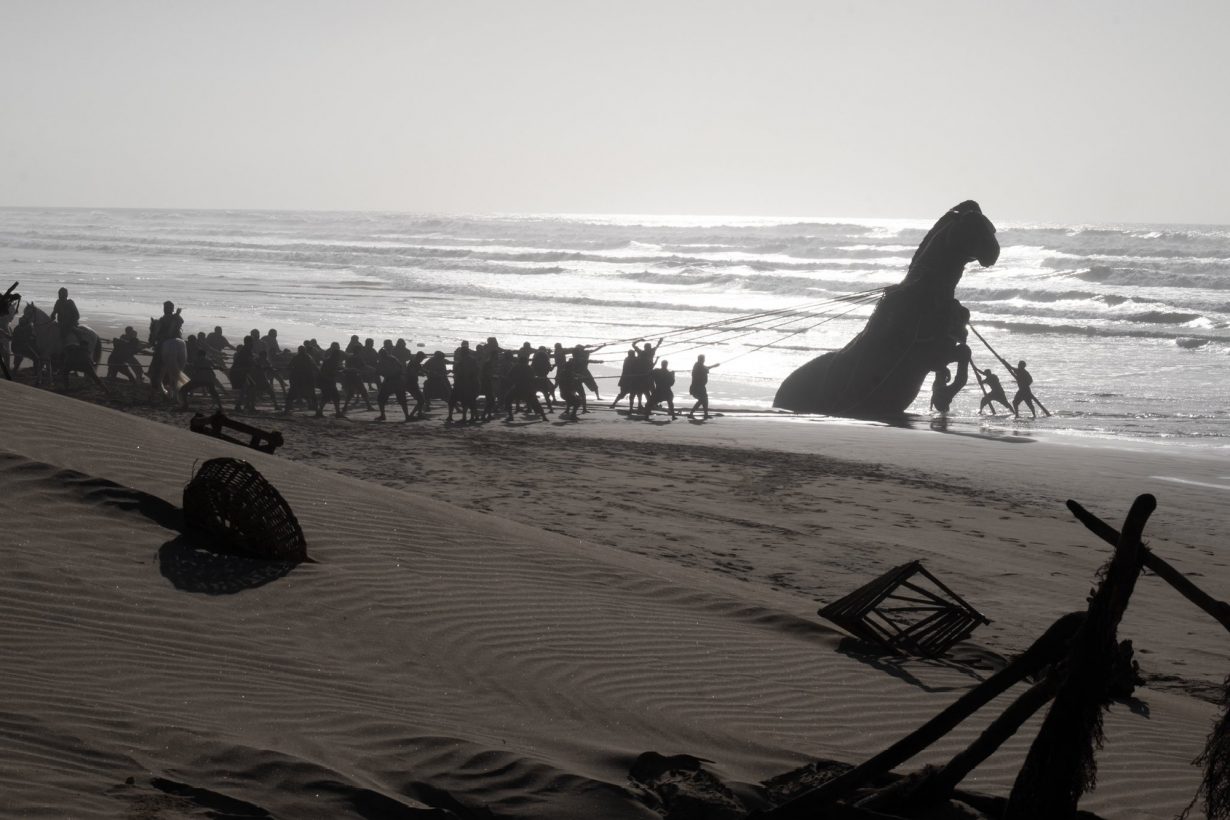
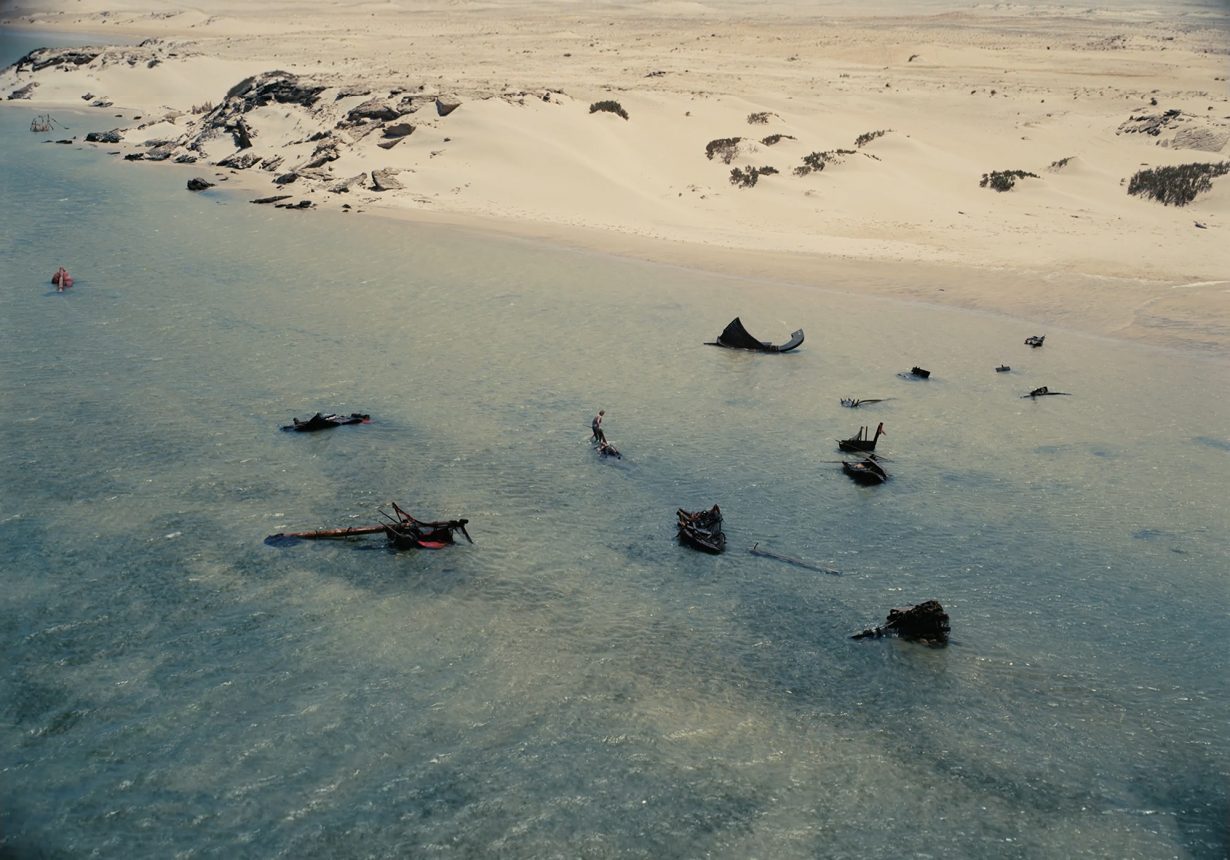
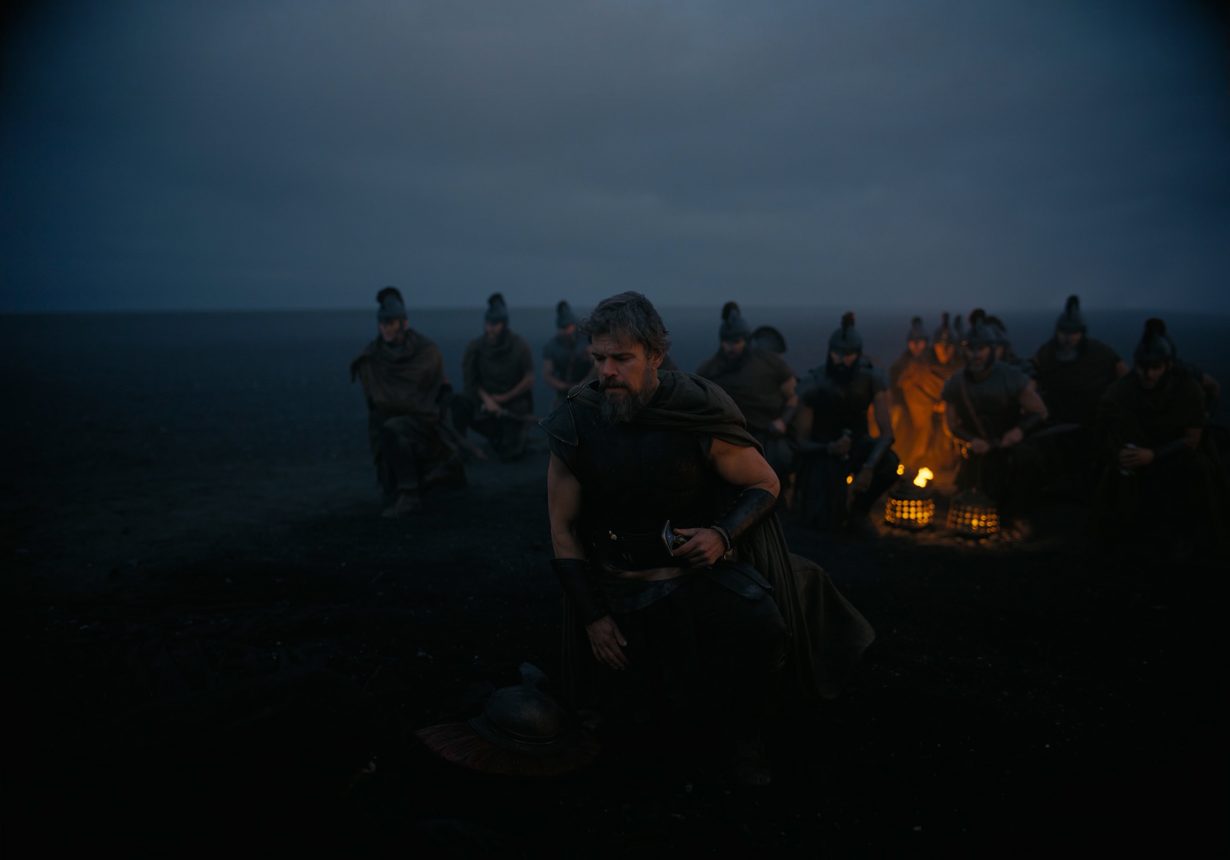
In the film’s opening scene, a banquet hall of irritable suitors surround a bard (Travis Scott) who shouts poetry enshrining their long-absent host in myth: “A war, a man, a trick – a trick to break the walls of Troy.” It’s been twenty years since Odysseus (Matt Damon) departed from Ithaca, and his memory is – if not beginning to fade – taking on the hazy contours of legend. Yet he remains flesh and bone. He’s alive yet stranded on an island, where he is scrubbed into a dazed, lotus-flower-pilled stupor by the hands of the nymph Calypso (Charlize Theron); it is his longest and final stop before returning home. From here, the rest of Odysseus’s story is told largely in retrospect as he struggles to remember the events leading up to this point. While he begins to piece together a creaky account of events – mostly, his men’s brutalisation by a cave-dwelling cyclops, sirens on the rocks and ironclad Laestrogynians – to his docile captor, Nolan stages a parallel drama following Odysseus’s wife Penelope (Anne Hathaway, twitching with contained fury) and son Telemachus (Tom Holland) as they fend off the horde of suitors led by the snivelling Antinous (Robert Pattinson). Telemachus embarks on small journeys of his own in search of his father, hoping to find confirmation of his death so that he might assume the throne. In Sparta, he meets Menalaus (Jon Bernthal) and Helen of Troy (Lupita Nyong’o), whose testimonies prompt flashback sequences to the infiltration of Troy by wooden gift-horse and the death of Agamemnon (Bennie Safdie, ridiculous in Batman armour) at the hands of Helen’s vengeful twin sister Clytemnestra (Nyong’o again in a Janus-faced part that’s over before you know it). In the Underworld, a penumbral desert blanketed in fog, Sinon (Elliot Page), the soldier fatefully tasked by Odysseus with presenting the horse to the Trojans, stews with the anger of all the men Odysseus has deceived and betrayed.
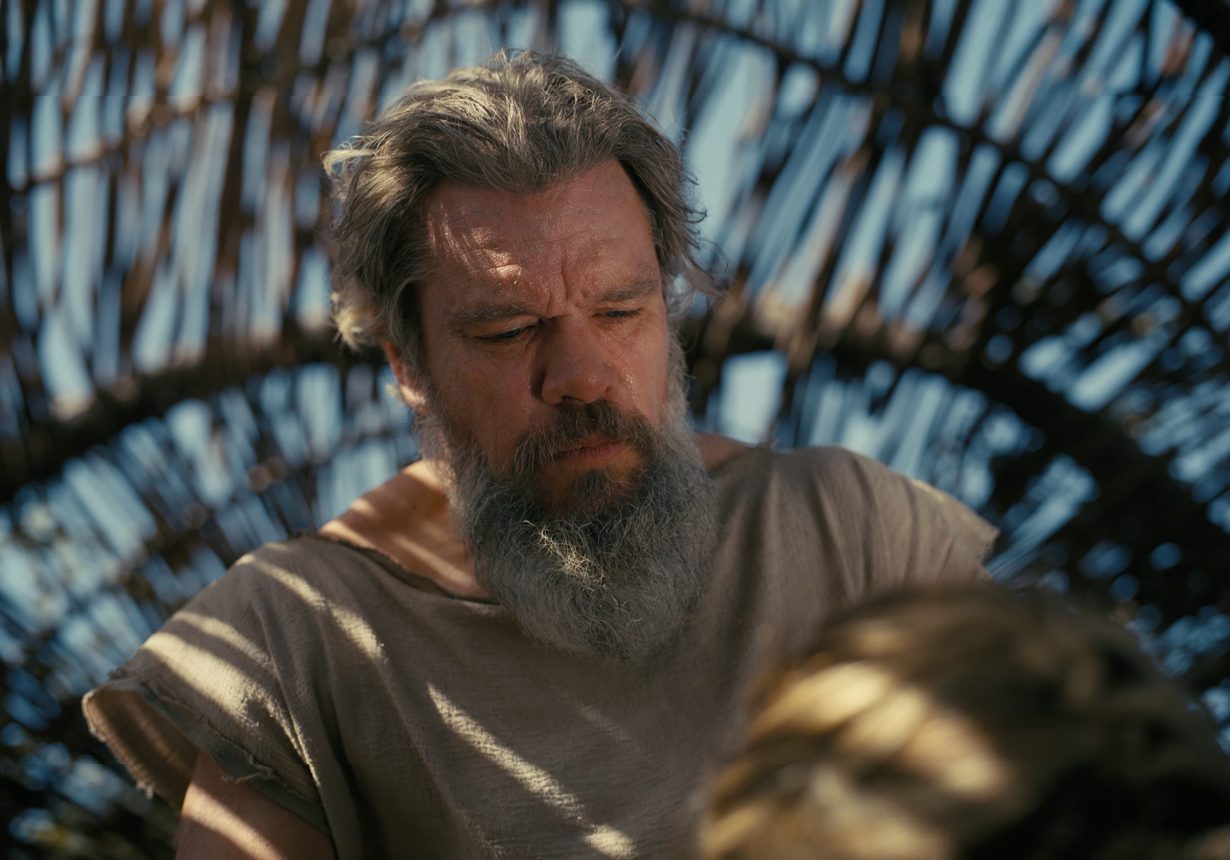
Shot entirely using IMAX cameras – the first film ever to do so – The Odyssey exploits its extra-large-screen format not for otherworldly immersion but for embodied intrigue. An odd reliance on close-ups adjusted with a shallow focus may not do justice to the film’s glittering coastlines and palatial sets, but it incidentally reorients and anchors the drama to the physicalities of its formidable ensemble cast: a single tear streaming down Telemachus’s cheek; the rouged clench of Odysseus’s bicep as he strings his bow; the fresh bruises encircling the cloudy blue eyes of Odysseus’s faithful swineherd Eumaeus (John Leguizamo) after he’s assaulted by the suitors’ cronies.
The action, as it were, plays out less convincingly on the battlefield than on the big, beautiful faces of its performers, making Nolan’s psychological rendering teem with affect – feeling, finally, coming first. Likewise, Hollywood starpower informs – and at times fills out – Nolan’s characterisations, his squad of supporting players adding texture and gravitas to the myth’s smallest building blocks, from Mia Goth as Penelope’s treacherous handmaiden to Logan Marshall-Green as Antinous’s tunic-clad Renfield. Pattinson’s Antinous, for his part, is a sociopathic aristocrat with the pretty-boy swagger of Ryan Phillippe in Cruel Intentions (1999), a theatrical rake whose comical cowardice cuts through the doom-and-gloom of Penelope’s court. (For his part, Pattinson has said he looked to James Woods’s smarmy grifter in Casino [1995] for inspiration.) Even the cast’s weakest talents, Zendaya and Holland, bring offscreen baggage that works in Nolan’s favour: Athena, the only god visualised in the film, is something like Odysseus’s imaginary friend, and her symbolic death in the climactic recapitulation of the sack of Troy feels particularly sacrilegious because of It-Girl Zendaya’s image of untouchability. Meanwhile, Holland, stiff as he is, brings the noble boyishness that cinched his place as Peter Parker, and with that character’s raspy American timbre to boot.
And then there is Matt Damon, a stocky know-it-all whose rippling masculinity and big brains have made him a natural leading man, albeit one whose confidence can easily veer into arrogance – a superiority complex central to Damon’s persona since Good Will Hunting (1997) through his supporting part in Nolan’s Interstellar (2014) and beyond. “That thing was a monster,” Damon’s hero says drily after he gratuitously launches a spear at the subdued cyclops; impatience and mild condescension flash across his face when others register shock at his indifference with burying the bodies of his dead. Nolan’s rationalist men could never make time for such mystic frivolity. Hollywood has often taught us to root for the wily underdog, the anti-establishment crusader, a predilection that makes Odysseus’s rebellion pleasurable to behold, even as the film shows him carelessly flouting the gods’ laws while also exploiting them to his advantage. If we’re meant to be impressed by the punishing devotion of Odysseus and his crew when they stuff themselves inside the Trojan horse, Nolan’s visualisation of its scummy, sweaty interior feels much less dignified; these men are bandits in the night. At the same time, Damon’s rugged charisma and plain-spoken pragmatism makes Odysseus’s cunning and secrecy feel righteous to an extent, a tension that Nolan indulges and fails to resolve beyond vesting him with guilt – call it flawed humanity or airbrushed mythmaking.
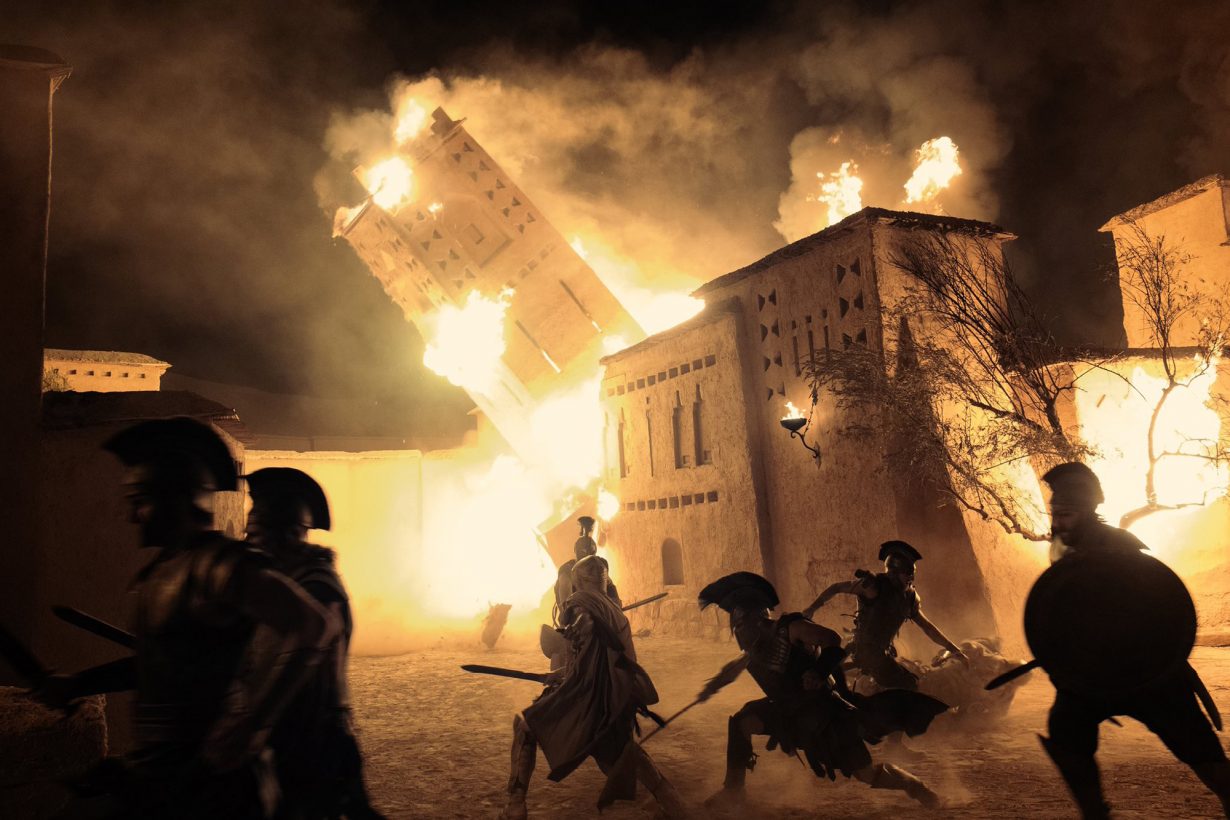
Nolan certainly shaves down the ruthlessnessness of Homer’s hero, creating a more populist Odysseus to match the cleaner (and more commercially viable) parameters of his ancient Greece. Frankly, the blood-and-semen soaked footprint left by Game of Thrones on the past decade-plus of swords-and-shield epics left me unfussed by Nolan’s restraint in all matters of carnal spectacle. In the theatre, at least, the film’s bracing sound design – the trotting of sheep echoing around an empty lair; the mushing and slurping of starving men hunched over bowls of stew – and score by Ludwig Göransson (snaking synths, metallic drums, and cryptic flutes) conveys its own visceral effect.
Likewise, the gods may be faceless in Nolan’s hands, but to consider them vanished misses the point: though invisible, they are felt in this world as the fickle tides and winds so rapturously conjured by Nolan’s practical effects; or in the Eeyore-eyes of Eurylochus (Himesh Patel), Odysseus’s lieutenant and closest confidante, which reflect back a conscience repressed in the name of survival and success. In this way, Nolan’s work of adaptation eschews not just the silliness of toga-clad deities perched in the heavens, or bellowing through rocks and fluffy cloud formations, but the itchiness of dogmatic truths. It is one thing to disobey the cruel authorities, another to ignore our moral instincts. This contemporary spirituality is a response to the very cynicism exhibited by men like Odysseus, whose lawlessness hinges on the absence of empirical certainty burning them otherwise. It takes not just a violent and protracted journey of slow and variegated deaths for him to grasp the consequences of his actions, but a painful session of recollection and self-interrogation; he is powerless in the face of the unknowable Gods. Love, to put it glibly, is all he has.
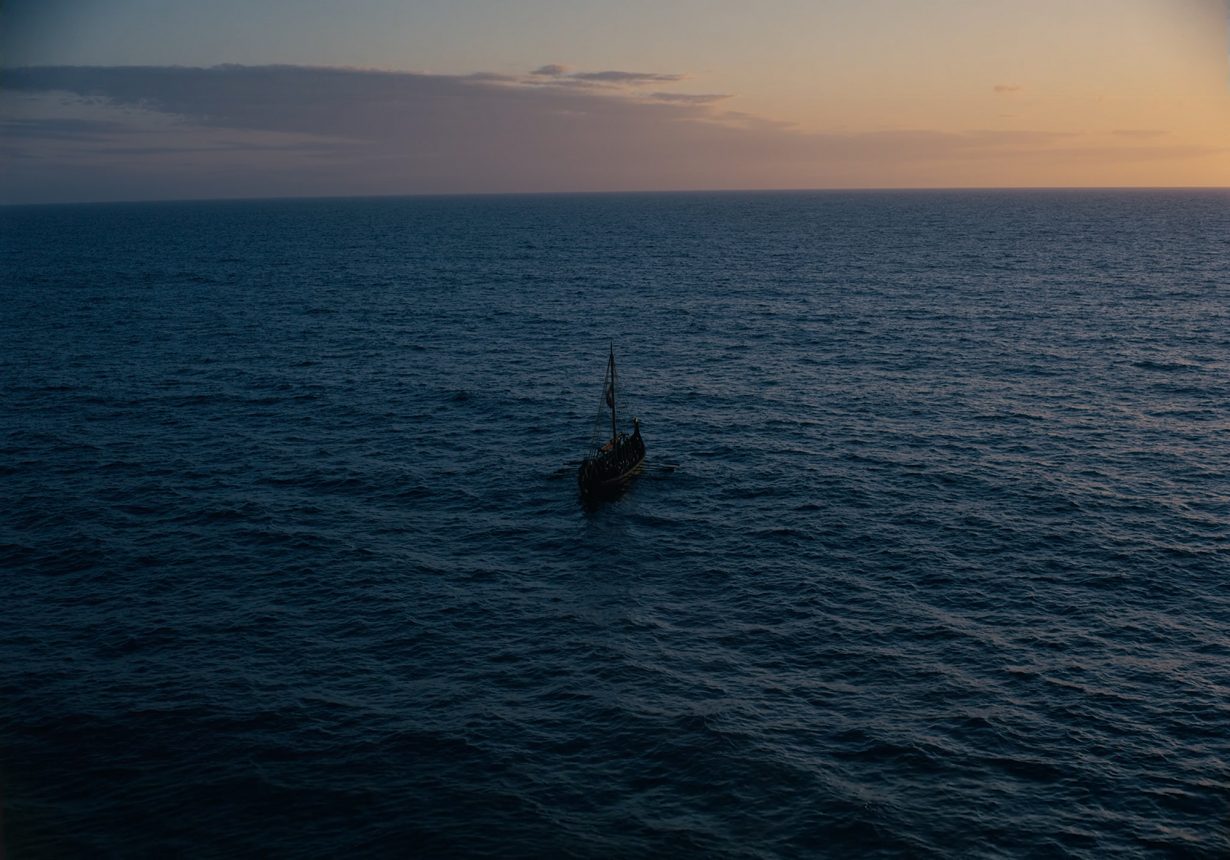
Odysseus’s return to Ithaca, his reunion with Telemachus, is powered by a dreary triumphalism that feels less intriguingly compromised by his dark past than even the climaxes of Nolan’s Batman joints (though it shares with The Dark Knight Rises a fairytale ending in which the hero retires to paradise with Anne Hathaway). Nolan’s ambivalence toward his hero is ultimately subsumed by his commitment to a romantic ideal – a faith in his evolution (via a kind of therapeutic breakthrough) that grants him transcendence through relinquished control. Nolan’s tendency to beat his recurring themes into a pulp and slather them across his scripts gets the best of him in this last act, but his images, for once, trump this shoddy narrative work across the film as a whole. In the end, Nolan’s message is perhaps annoyingly basic for the richness of the source text, and yet it’s conveyed with the kind of grand, expressive force suited both to the weight of the myth and the big-screen blockbusters that are Nolan’s stock-and-trade. When Odysseus finally remembers Penelope, he’s flooded with guilt over everything he’s done and everyone he’s abandoned, which Damon communicates by suddenly pulling his face into a trembling squint. In Calypso’s beachy lair, his face is encircled by earthy neutrals; his emotion, the star of the show – his is a matter of truly feeling it.