The poet considers what art is, the importance of ritual, playing the market, and whether or not AI is going to screw us all
Ana María Caballero first made a name for herself in the literary world via multiple award-winning poetry collections that explore themes including the body, gender and cultural expectations, love, grief and vulnerability, as well as language and poetry itself. For the better part of the last decade, she has also actively worked to present poetry beyond the page and increase its presence in the artworld. The Madrid- and Miami-based, Colombian-American first accomplished this by digitising her poems and putting them on various blockchains as individual works of art. In 2021 she then cofounded the Web3 poetry gallery theVERSEverse and in 2024 Sotheby’s sold her poem ‘Cord’ via Bitcoin, marking the auction house’s first crypto sale of an individual poem and the first time it had sold a poem by a living poet.
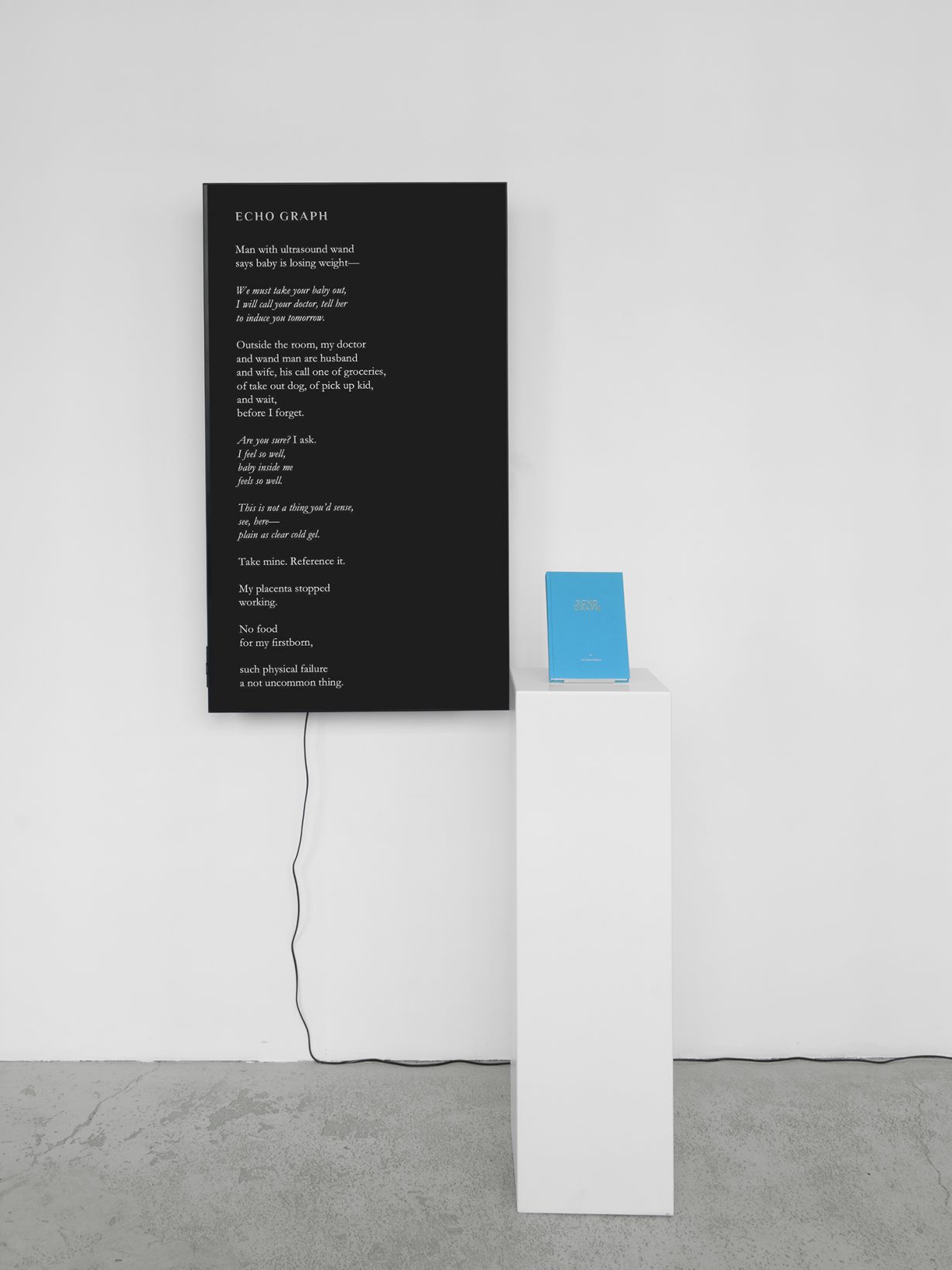
‘Cord’ first appeared in Caballero’s collection Mammal (2024), which offers intimate meditations on pregnancy, motherhood and the body. Beyond minting ‘Cord’ as an NFT, Caballero expanded another poem from the collection, ‘Echo Graph’, into an entire exhibition in 2025 at the gallery Office Impart in Berlin. Among prints and a conceptual wall-sculpture deriving from a process involving performance and AI, the show centred a video made with motion-capture technology that placed an abstracted version of Caballero’s body into a womb (Echo Graph, 2024) and a single-edition book repeating the eponymous poem 197 times (Echo Graph, Book Sculpture series, 2024). Whoever acquired the latter was to also receive a video of the poem’s text with Caballero reading it aloud, as well as an inscription of it on the bitcoin blockchain. Embodying a poem about her ultimately unnecessary and traumatic emergency C-section was an act that allowed Caballero to reclaim her body from the hands of the doctors attending the birth and, more generally, the medical-industrial complex. Ahead of her first institutional survey, Read the Room, at the Francisco Carolinum museum in Linz, Austria, Caballero speaks about expanding her poems into other forms, the blockchain as a storage mechanism and market tool, and the literary implications of artificial intelligence.

What Is Art?
ArtReview I want to use your project Fifty Ways of Looking at a Poem as a kind of case study, because it encapsulates a lot of what you’re doing in different forms. It began with one poem, which you gave to 50 different people to annotate. The annotated poems then grew into an installation, performance, video and collection of poems on the blockchain. Where did the idea for this project come from?
Ana María Caballero Everyone is always trying to define ‘what is art’, and for me, art is the moment you encounter a poem that you love so much, you want to mark it up – you want to circle something, you want to leave your own residue on it. That also happens when you see an artwork – you want to take a picture of it or read more about it, though of course you can’t really mark it up. For me, this sense of wanting to immerse yourself in something so fully is where art lives. So, with this project, I wanted to elevate and turn that moment of connection into the art itself.
AR What was that process like?
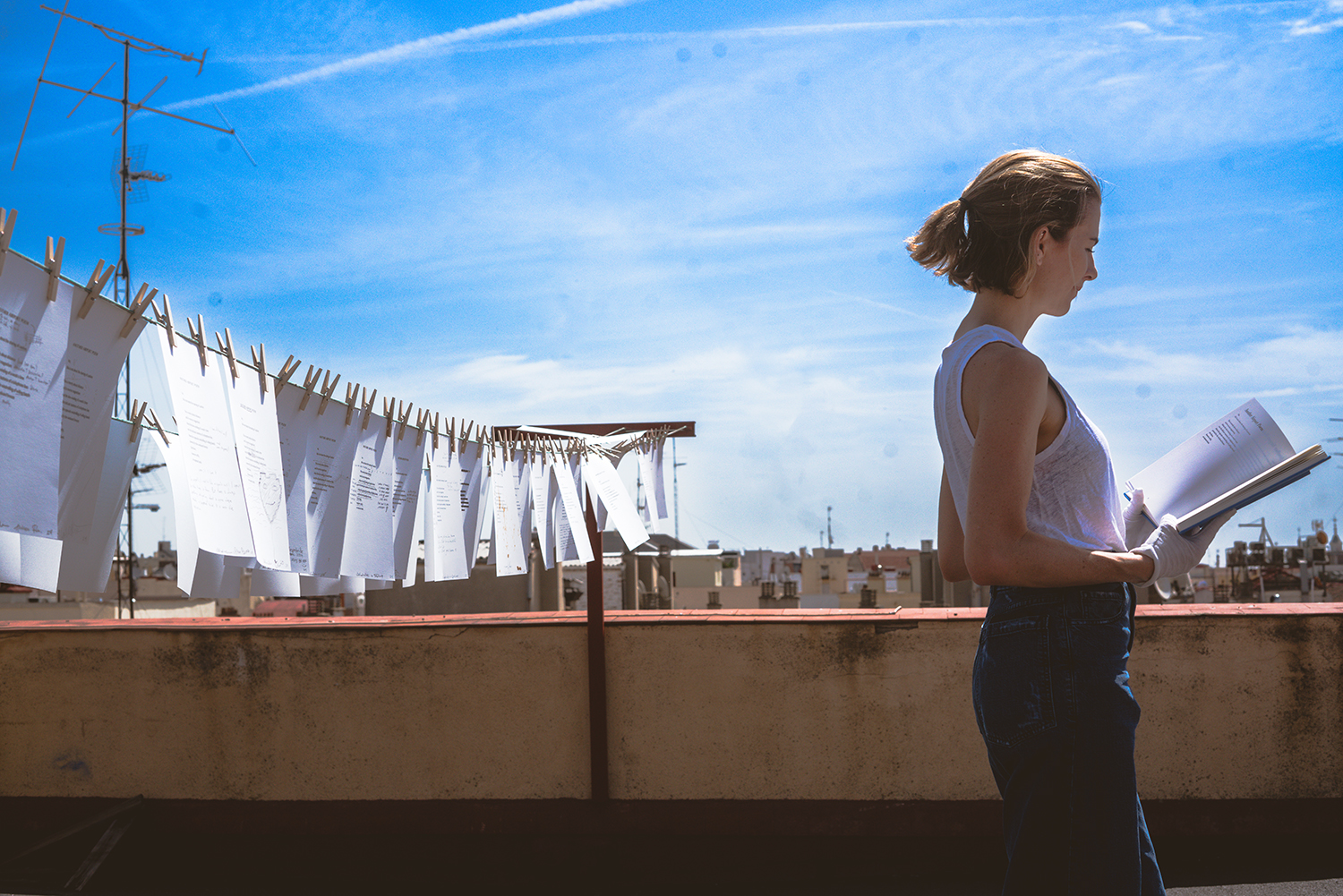
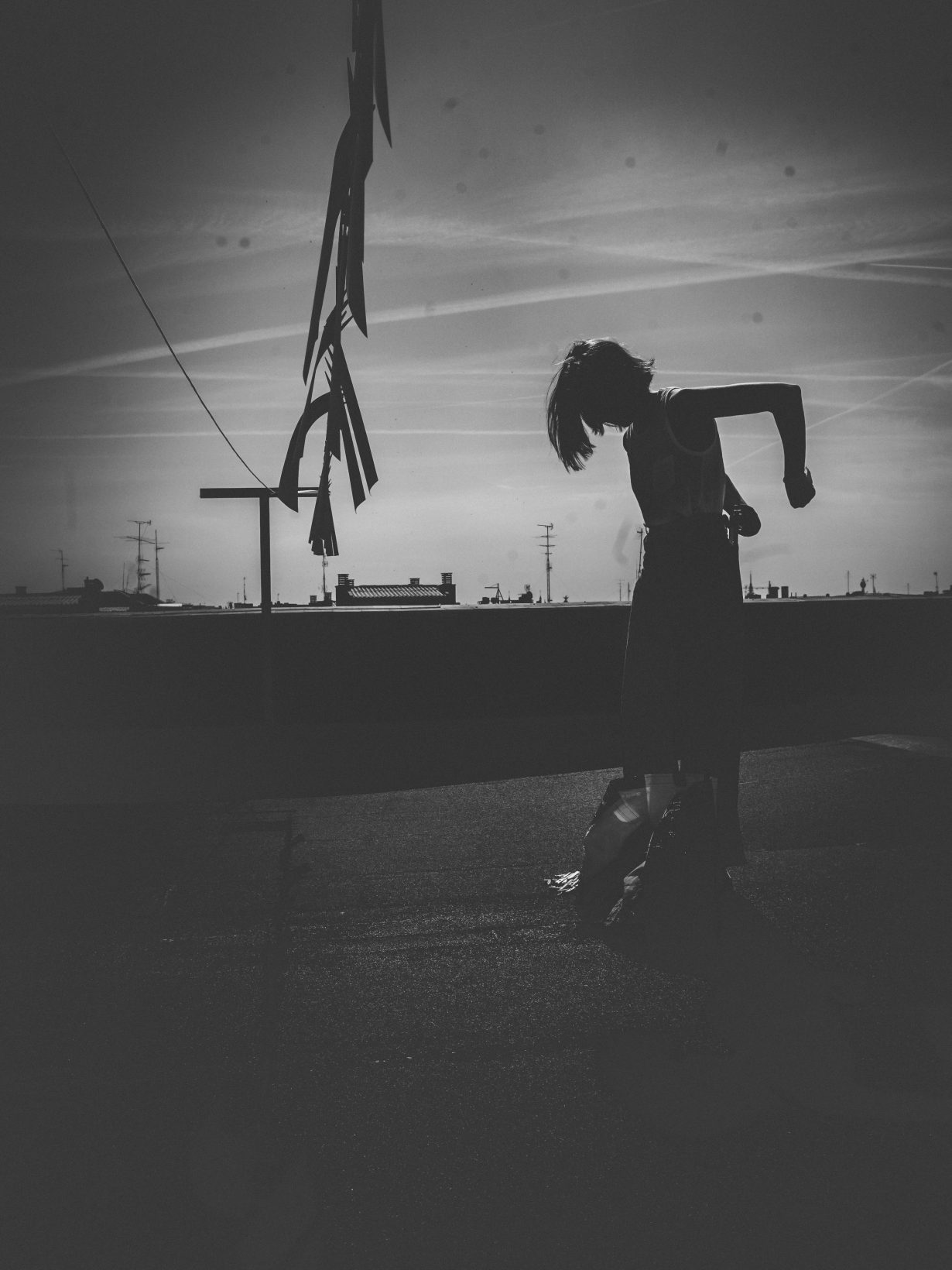
AMC I started by writing a short love poem titled ‘Another Airport Poem’ and then I asked 50 people to annotate it. The 50 different ways the poem was marked up expressed the infinite possibilities of readership. If I were to give these 50 people the same poem today, I guarantee they would each do something different because context changes, it evolves. Then I digitised the annotated poems and offered each of them as an NFT. I kept the physical ones as a singular body of work. And then I filmed a durational performance in which I took each poem out of a grocery-store bag and hung them on a clothing line, which speaks to a recurring theme in my work: the mundane. I believe we access the transcendental through the mundane.
AR What kind of transcendental experience did you have by way of hanging poems as laundry?
AMC It felt very devotional. It felt like a ritual. It felt like I was really honouring the work of writing. It’s so hard to be a writer, to get published, to share your work, to share yourself. It felt like an aching devotion to hang these up and to affirm each of them as something that deserved to be out in the light of day.
AR I want to talk more specifically about the digital component of your work. To put it bluntly, what is the point of digitising a poem that otherwise remains exactly the same?
AMC The purpose is more readers, more connection. It’s magic to see the tactile nature of the poems – the colours, the pen marks – in person, but when they’re digital, you can share them so widely.
Playing the Market
AR But you could do all of this with photos of the poems. Why mint them as NFTs?
AMC To participate in the artworld, you have to acknowledge that there is an art market. With blockchain, you have digital provenance and the digital asset becomes very easily verified without the need of a hardware component. This makes the work easily and readily transactable and opens it up to a whole other audience – and if you’re participating in the art market in a way that people view as successful, then you’ll undoubtedly have more opportunities. The fact that Fifty Ways of Looking at a Poem sold out digitally gave it a special aura, and in turn the physical poems and overarching body of work have received more attention. But there are also conceptual components. The page is a record-keeping mechanism, as is the book, as is grammar, as is language, as is video. The blockchain, to me, is within that lineage. It’s part of the evolution from page to pixel to decentralised ledger. Books can last for centuries, but there is a decay. There’s a permanence to the blockchain as a record-keeping mechanism that I find compelling. Putting a poem on the blockchain, for me, is like carving it in stone. You’re carving it into the stones of the future.
The Importance of Outreach
AR Was it these thoughts that led to the founding of theVERSEverse?
AMC Yes, definitely. But there was also another component, which is participation. Poets need to participate in spaces where we’re typically not. You typically don’t see poetry in a commercial gallery setting. I wanted poetry to participate in a way that felt equal to the way society reveres and values it, but also to create exhibitions around the work. When theVERSEverse became successful, the Tezos blockchain gave us two grants, which helped fund a lot of work that truly had no commercial aims – the point was to share digital poetry and give people different ideas of what poems could look like, how they could feel, how they could dance and sing.
AR Some poets working in the digital space, including some involved with theVERSEverse, use AI as a collaborator in writing. You also use AI but in a different way. What are your interests in AI?
AMC I’m interested in the literary implications of text-to-image generative AI. When you’re working with a text-to-image generator, you are bending language, reworking sentence structure, editing, compressing, changing words, underlining and adding emphasis to try and get the image you want. That is a new form of writing, a new use of language, and I want to observe it and acknowledge it.
AR Have you written any poems in a way that mimics this type of writing?
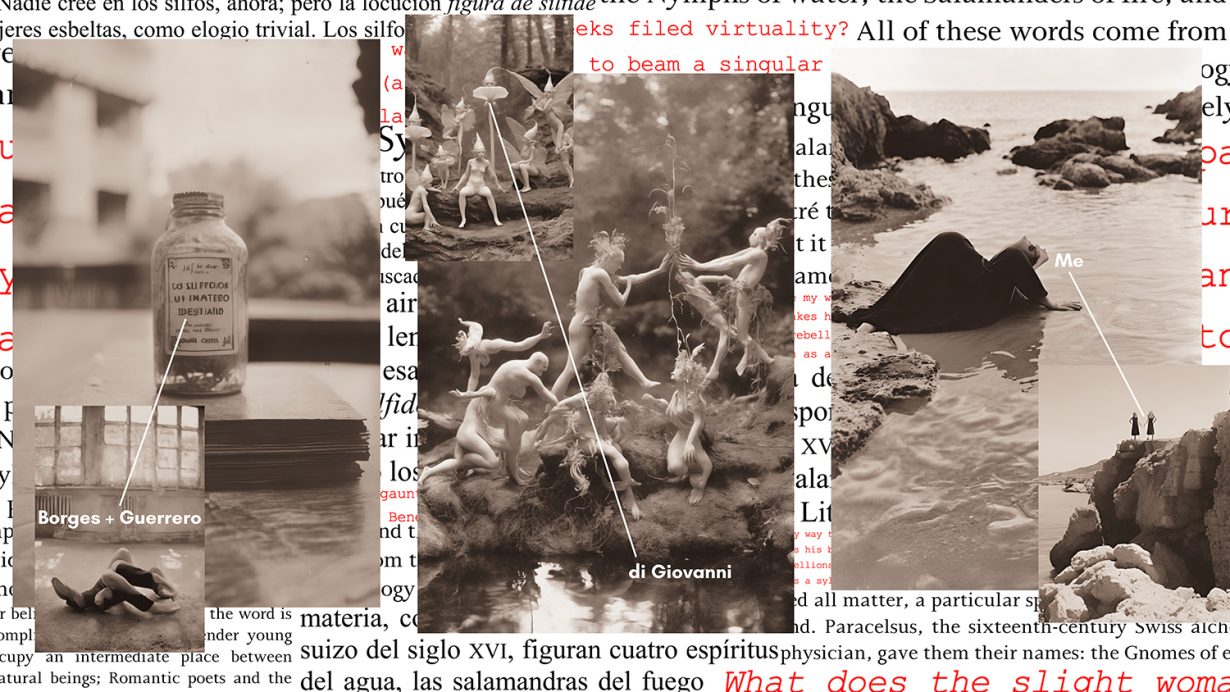
AMC My project Being Borges (2023–26) uses text-to-image generative AI to visualise the literary descriptions of creatures from Jorge Luis Borges and Margarita Guerrero’s The Book of Imaginary Beings [1957], its 1969 English translation by Norman Thomas di Giovanni and poems inspired by the original Spanish texts that I write myself. In the poems that I write, I use text-toimage generation semantics, like the bracket and the parentheses. Some text-to-image generative AI software has evolved beyond that, but in the early days, the parentheses added emphasis, the bracket took it away. If you read my poems, you’ll see that the brackets and the single, double and triple parentheses are placed very purposefully. They add elements of meaning and emphasis to the poem, but they are also used in places where I didn’t want the AI to pick up the text.
The Thing About AI…
AR I want to ask you about copyright, because it’s a point of contention for many artists and writers right now with regard to AI. Is this something you’re thinking about or concerned with?
AMC The big tech companies are, of course, abusive. We all know that and it needs to be addressed. But, generally, I see copyright more from the lens of intertextuality. I’ve engaged very meaningfully with Borges’s body of literature. I’m now developing a project with the work of Federico García Lorca. We’re always writing and creating on the shoulders of giants, of other artists. So I don’t have a very possessive point of view over my own work. I don’t think it needs to be protected from being used in AI. I don’t have that sense of building a barrier around me like a wall and needing to contain all my work. I see it as all very porous.
AR Lastly, zooming out, how would you summarise the significance of transforming poetry into all these other forms?
AMC As poets, we’re taught to present the work in one format. Yes, it needs to be on the page, but if you also allow the poem to exist otherwise, to expand itself into a different body, into a different medium, then other individuals will be able to connect with it and it will multiply in its meanings.
Read the Room, an exhibition of work by Ana María Caballero, is on show at Francisco Carolinum, Linz, through 7 February
From the September 2026 issue of ArtReview – get your copy.